
How to Find Pump Work in the Rankine Cycle

Quick Summary: To find pump work in a Rankine cycle, use the formula Wp = vΔP, where ‘v’ is the specific volume of the liquid entering the pump and ‘ΔP’ is the pressure difference across the pump. Alternatively, if you know the enthalpy values, use Wp = h2 – h1, where h1 and h2 are the enthalpies at the pump’s inlet and outlet, respectively. Remember to account for the pump’s efficiency to get the actual pump work.
Hey there, fellow cyclists! Raymond Ammons here from BicyclePumper.com. Ever wondered how power plants work? The Rankine cycle is a fundamental principle behind many of them. Now, you might be thinking, “What does this have to do with bikes?” Well, understanding the basics of thermodynamics can help you appreciate the efficiency and engineering that goes into everything around us, even your trusty bicycle pump! A common challenge is figuring out the work required by the pump in this cycle. It might seem complex, but I’m here to break it down for you step-by-step.
In this guide, we’ll walk through the process of calculating pump work in a Rankine cycle, using simple explanations and practical examples. By the end, you’ll have a clear understanding of the formulas and steps involved. Ready to dive in? Let’s get started!
Understanding the Rankine Cycle

Before we dive into the specifics of finding pump work, let’s quickly recap what the Rankine cycle is all about. It’s the basic thermodynamic cycle used by most power plants, including coal-fired, nuclear, and solar thermal plants. It converts heat into mechanical work, which then drives a generator to produce electricity.
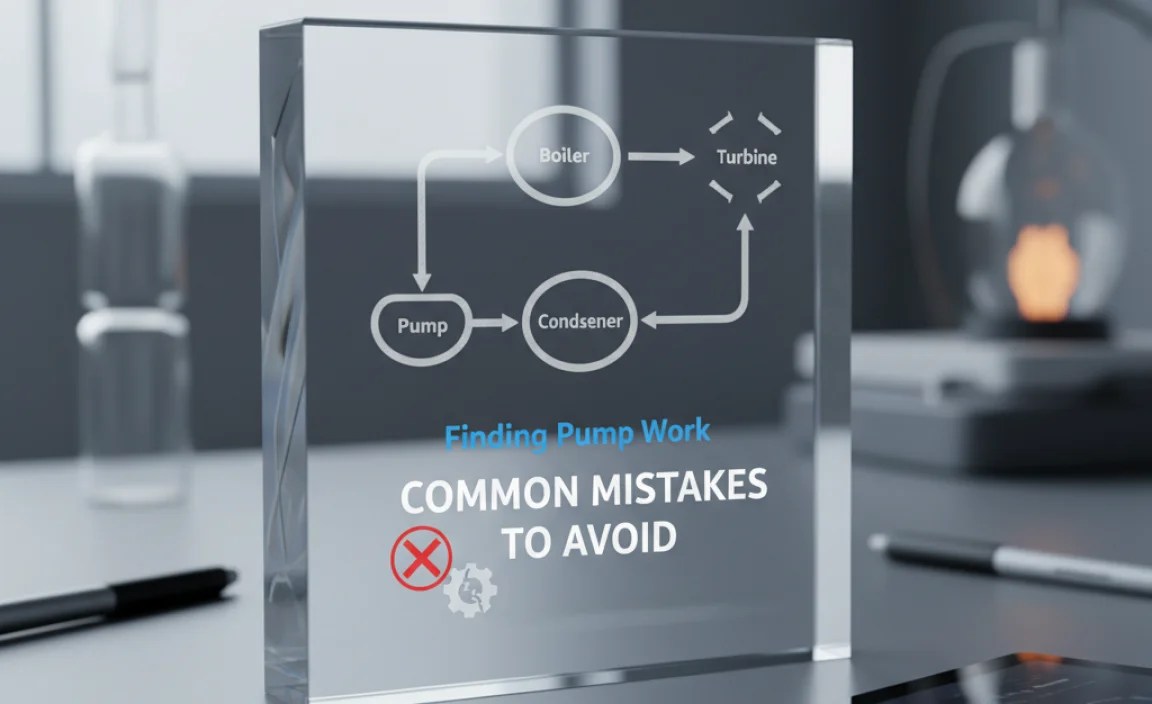
The Rankine cycle consists of four main components:
- Pump: Increases the pressure of the working fluid (usually water)
- Boiler: Heats the high-pressure water to create steam
- Turbine: Expands the high-pressure steam to generate power
- Condenser: Cools the steam to convert it back into water
The pump is essential because it prepares the working fluid for the high-pressure conditions required in the boiler. Figuring out how much work the pump needs is crucial for understanding the overall efficiency of the cycle.
Why is Pump Work Important?

Calculating pump work is more than just an academic exercise. It’s vital for:
- Efficiency Analysis: Knowing the pump work helps determine the overall efficiency of the Rankine cycle.
- System Design: Accurate pump work calculations are essential for designing the pump itself and integrating it into the system.
- Cost Estimation: Pump work directly relates to the energy consumption of the pump, affecting operational costs.
In short, understanding pump work ensures that power plants operate efficiently and cost-effectively.
Step-by-Step Guide to Finding Pump Work

Alright, let’s get down to business. Here’s how you can find pump work in the Rankine cycle, broken down into simple steps:
Step 1: Gather the Necessary Information
First, you’ll need some key data. This includes:
- Specific Volume (v): The volume occupied by a unit mass of the liquid entering the pump. This is usually given in m³/kg or ft³/lbm.
- Inlet Pressure (P1): The pressure of the liquid entering the pump.
- Outlet Pressure (P2): The pressure of the liquid exiting the pump.
- Enthalpy at Inlet (h1): The enthalpy of the liquid entering the pump.
- Enthalpy at Outlet (h2): The enthalpy of the liquid exiting the pump.
- Pump Efficiency (ηp): The efficiency of the pump, if you want to calculate the actual pump work.
This information is usually provided in the problem statement or can be found in thermodynamic tables for water.
Step 2: Choose the Right Formula
There are two main formulas you can use to calculate pump work. The choice depends on the information you have available.
Formula 1: Using Specific Volume and Pressure Difference
This formula is based on the assumption that the liquid is incompressible, which is a reasonable approximation for water in most Rankine cycle applications. The formula is:
Wp = v * (P2 – P1)
Where:
- Wp = Pump work (J/kg or BTU/lbm)
- v = Specific volume of the liquid (m³/kg or ft³/lbm)
- P2 = Outlet pressure (Pa or psi)
- P1 = Inlet pressure (Pa or psi)
Formula 2: Using Enthalpy Difference
This formula uses the change in enthalpy across the pump:
Wp = h2 – h1
Where:
- Wp = Pump work (J/kg or BTU/lbm)
- h2 = Enthalpy at the outlet (J/kg or BTU/lbm)
- h1 = Enthalpy at the inlet (J/kg or BTU/lbm)
This method is generally more accurate, especially when dealing with significant temperature changes or when the liquid is not strictly incompressible.
Step 3: Calculate Ideal Pump Work
Using the chosen formula and the data you gathered, calculate the ideal pump work. This is the work the pump would require if it were perfectly efficient.
Example 1: Using Specific Volume and Pressure Difference
Let’s say we have the following data:
- Specific volume (v) = 0.001 m³/kg
- Inlet pressure (P1) = 10 kPa
- Outlet pressure (P2) = 10 MPa = 10,000 kPa
Using the formula Wp = v * (P2 – P1):
Wp = 0.001 m³/kg * (10,000 kPa – 10 kPa)
Wp = 0.001 m³/kg * 9990 kPa
Wp = 9.99 kJ/kg
So, the ideal pump work is approximately 9.99 kJ/kg.
Example 2: Using Enthalpy Difference
Suppose we have the following data:
- Enthalpy at inlet (h1) = 160 kJ/kg
- Enthalpy at outlet (h2) = 170 kJ/kg
Using the formula Wp = h2 – h1:
Wp = 170 kJ/kg – 160 kJ/kg
Wp = 10 kJ/kg
In this case, the ideal pump work is 10 kJ/kg.
Step 4: Account for Pump Efficiency
Real-world pumps aren’t perfectly efficient. To find the actual pump work, you need to account for the pump’s efficiency (ηp). The formula is:
Wp,actual = Wp,ideal / ηp
Where:
- Wp,actual = Actual pump work
- Wp,ideal = Ideal pump work (calculated in Step 3)
- ηp = Pump efficiency (expressed as a decimal, e.g., 80% efficiency = 0.80)
Example: Accounting for Efficiency
Using the ideal pump work from Example 1 (9.99 kJ/kg) and assuming a pump efficiency of 80% (0.80):
Wp,actual = 9.99 kJ/kg / 0.80
Wp,actual = 12.49 kJ/kg
So, the actual pump work is approximately 12.49 kJ/kg.
Practical Considerations and Tips

Here are some additional tips to keep in mind when finding pump work:
- Units: Always ensure that your units are consistent. Convert all values to a standard set of units (e.g., SI units) before performing calculations.
- Thermodynamic Tables: Use accurate thermodynamic tables or software to find specific volume and enthalpy values. Sites like the NIST Chemistry WebBook can be helpful.
- Assumptions: Be aware of the assumptions you’re making, such as the incompressibility of water. For high-precision calculations, consider more complex models.
- Real-World Factors: Remember that real-world pumps have losses due to friction, leakage, and other factors. The pump efficiency accounts for these losses, but it’s still an approximation.
Common Mistakes to Avoid
Here are some common mistakes that beginners often make when calculating pump work:
- Incorrect Units: Using inconsistent units can lead to significant errors. Always double-check your units.
- Ignoring Pump Efficiency: Forgetting to account for pump efficiency will give you an unrealistic estimate of the pump work.
- Using the Wrong Formula: Choosing the wrong formula for the available data can result in incorrect calculations.
- Misreading Thermodynamic Tables: Make sure you’re reading the thermodynamic tables correctly and using the appropriate values for your conditions.
Advanced Techniques and Considerations
For more advanced analysis, consider these points:
- Variable Specific Volume: In some cases, the specific volume of the liquid may change significantly across the pump. Use an average value or integrate the specific volume over the pressure range for more accurate results.
- Non-Ideal Pumps: Real pumps may have complex performance characteristics. Use pump performance curves or models to estimate pump work more accurately.
- Computational Fluid Dynamics (CFD): For highly detailed analysis, use CFD simulations to model the flow within the pump and calculate pump work.
Tools and Resources
Here are some useful tools and resources for calculating pump work:
- Thermodynamic Tables: Printed or online tables providing thermodynamic properties of water and other substances.
- Thermodynamic Software: Software packages like EES (Engineering Equation Solver) or similar tools can automate calculations and provide accurate results.
- Online Calculators: Many websites offer online calculators for thermodynamic calculations. Just be sure to verify their accuracy.
Real-World Applications
Understanding pump work isn’t just theoretical. It has many real-world applications, including:
- Power Plant Design: Optimizing the pump design to minimize energy consumption and improve overall efficiency.
- HVAC Systems: Calculating the pump work in heating, ventilation, and air conditioning systems to ensure efficient operation.
- Chemical Processing: Determining the pump work in chemical plants for pumping various fluids.
Comparing Methods: Specific Volume vs. Enthalpy
Let’s take a closer look at the two main methods for calculating pump work and compare their strengths and weaknesses:
| Method | Formula | Advantages | Disadvantages | Best Use Case |
|---|---|---|---|---|
| Specific Volume and Pressure Difference | Wp = v * (P2 – P1) | Simple to use, requires minimal data | Assumes incompressible fluid, less accurate for large temperature changes | Quick estimates, basic Rankine cycle analysis |
| Enthalpy Difference | Wp = h2 – h1 | More accurate, accounts for temperature changes | Requires enthalpy data, may need thermodynamic tables | Detailed analysis, high-precision calculations |
The Impact of Pump Efficiency
Pump efficiency plays a crucial role in the overall performance of the Rankine cycle. A higher efficiency means less energy is wasted, resulting in lower operating costs and reduced environmental impact. Here’s a table illustrating the impact of pump efficiency on actual pump work:
| Pump Efficiency (%) | Ideal Pump Work (kJ/kg) | Actual Pump Work (kJ/kg) |
|---|---|---|
| 100 | 10 | 10 |
| 90 | 10 | 11.11 |
| 80 | 10 | 12.50 |
| 70 | 10 | 14.29 |
| 60 | 10 | 16.67 |
As you can see, as the pump efficiency decreases, the actual pump work increases significantly. This highlights the importance of selecting high-efficiency pumps for Rankine cycle systems.
FAQ: Finding Pump Work in Rankine Cycle
Here are some frequently asked questions about finding pump work in the Rankine cycle:
Q1: What is specific volume, and why is it important?
A: Specific volume is the volume occupied by a unit mass of a substance (usually measured in m³/kg or ft³/lbm). It’s important because it helps relate the volume of the fluid to its mass, which is essential for calculating pump work using the formula Wp = vΔP.
Q2: Where can I find the specific volume and enthalpy values?
A: You can find these values in thermodynamic tables for water or using thermodynamic software. Online resources like the NIST Chemistry WebBook are also helpful.
Q3: What if the pump efficiency is not given?
A: If the pump efficiency isn’t provided, you can either assume a typical value (e.g., 80% for a well-maintained pump) or look up typical efficiency values for the type of pump being used in engineering handbooks.
Q4: Why is the pump work usually much smaller than the turbine work in a Rankine cycle?
A: The pump handles liquid, which has a much smaller specific volume than steam. Since pump work is proportional to specific volume, it requires significantly less work to pump the liquid compared to the work produced by the turbine expanding the steam.
Q5: Can I use the same formulas for different working fluids, like ammonia or refrigerants?
A: Yes, the formulas are the same, but you’ll need to use thermodynamic tables or software that provide specific volume and enthalpy values for the specific working fluid you’re using.
Q6: How does the temperature of the water affect pump work?
A: Temperature affects the specific volume and enthalpy of the water. Higher temperatures generally lead to slightly higher specific volumes and enthalpies, which can influence the pump work calculation. Always use values corresponding to the actual temperature conditions.
Q7: What is the difference between ideal and actual pump work?
A: Ideal pump work assumes a perfectly efficient pump with no losses. Actual pump work accounts for the pump’s efficiency, which reflects real-world losses due to friction, leakage, and other factors. Actual pump work is always higher than ideal pump work.
Conclusion
So, there you have it! Calculating pump work in the Rankine cycle might seem daunting at first, but with the right formulas and a step-by-step approach, it becomes much more manageable. Whether you’re using specific volume and pressure differences or enthalpy values, remember to account for pump efficiency to get a realistic estimate. This knowledge is crucial for anyone involved in power plant design, HVAC systems, or any application that relies on thermodynamic cycles.
Now that you’ve mastered finding pump work in the Rankine cycle, you’re one step closer to understanding the intricate workings of power generation. Keep exploring, keep learning, and remember that even complex topics can be broken down into simple, understandable steps. And as always, keep those tires pumped and those bikes rolling!
“`


