
Is a Heat Engine a Heat Pump or Power Cycle? Understanding the Basics

Quick Summary: A heat engine isn’t *either* a heat pump *or* a power cycle; it *is* a power cycle. Heat engines convert thermal energy into mechanical work. Heat pumps, on the other hand, move heat from a cold reservoir to a hot one, requiring work to operate. They have different functions, even though they use similar principles of thermodynamics.
Ever wondered about the real difference between a heat engine and a heat pump? It’s a common question, and it can be a bit confusing since they both deal with heat. But don’t worry! We’re going to break down exactly what each one does in simple terms. We’ll look at how they work and what makes them different. By the end, you’ll know exactly how to tell them apart. Let’s get started!
What is a Heat Engine?
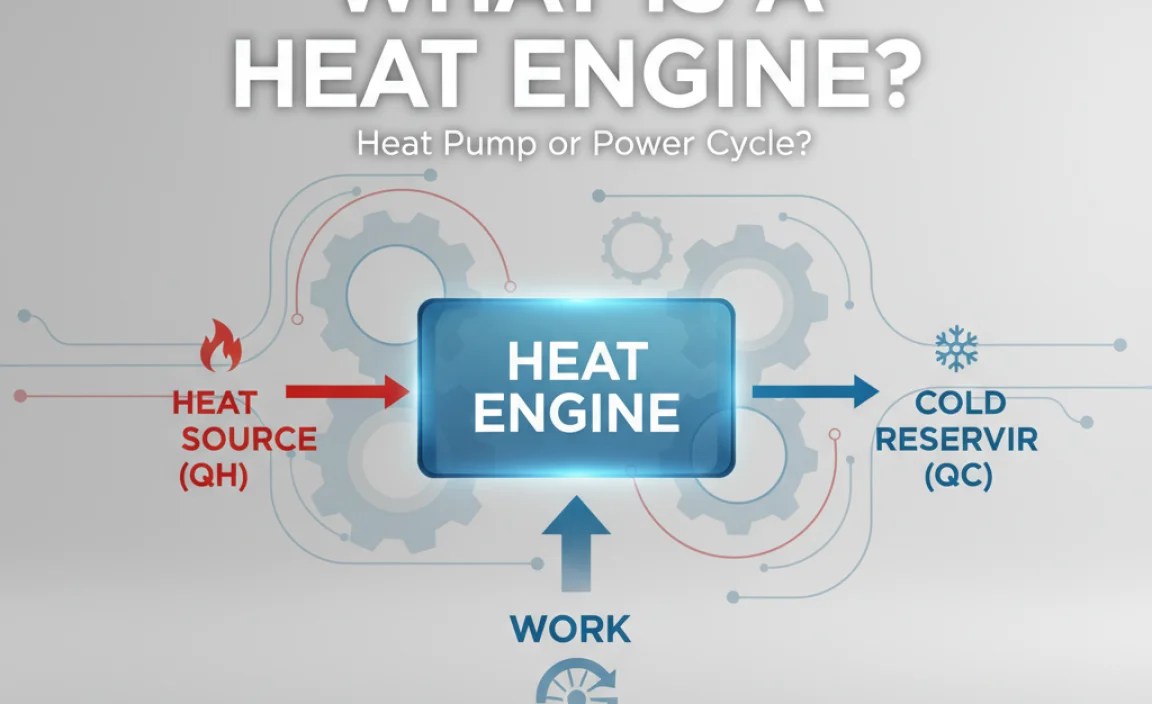
A heat engine is a system that transforms thermal energy into mechanical work. Think of it as a machine that takes heat and turns it into movement or power. To understand this better, consider these key aspects:
- Function: Converts heat into work.
- Input: Requires a high-temperature heat source and a low-temperature heat sink.
- Output: Produces mechanical work.
- Examples: Internal combustion engines in cars, steam turbines in power plants.
Heat engines operate using a thermodynamic cycle. This cycle typically involves the following steps:
- Heat Absorption: The engine absorbs heat from a high-temperature source.
- Work Output: Part of this heat is converted into mechanical work.
- Heat Rejection: The remaining heat is rejected to a low-temperature sink.
The efficiency of a heat engine is determined by how much of the input heat is converted into useful work. The higher the efficiency, the better the engine is at converting heat into work.
The Carnot Cycle: A Theoretical Ideal
The Carnot cycle is a theoretical thermodynamic cycle that represents the most efficient possible way to convert heat into work, or vice versa. Although it’s an idealization, it provides a benchmark for real-world heat engines. Here’s a breakdown:
- Isothermal Expansion: The system absorbs heat at a constant high temperature, doing work.
- Adiabatic Expansion: The system continues to expand and do work, but without any heat exchange.
- Isothermal Compression: The system releases heat at a constant low temperature, requiring work to be done on it.
- Adiabatic Compression: The system is compressed back to its initial state without any heat exchange.
The Carnot cycle highlights the importance of temperature differences in achieving high efficiency. Real-world engines can’t reach Carnot efficiency due to factors like friction and non-ideal gas behavior, but it provides a crucial theoretical limit.
What is a Heat Pump?
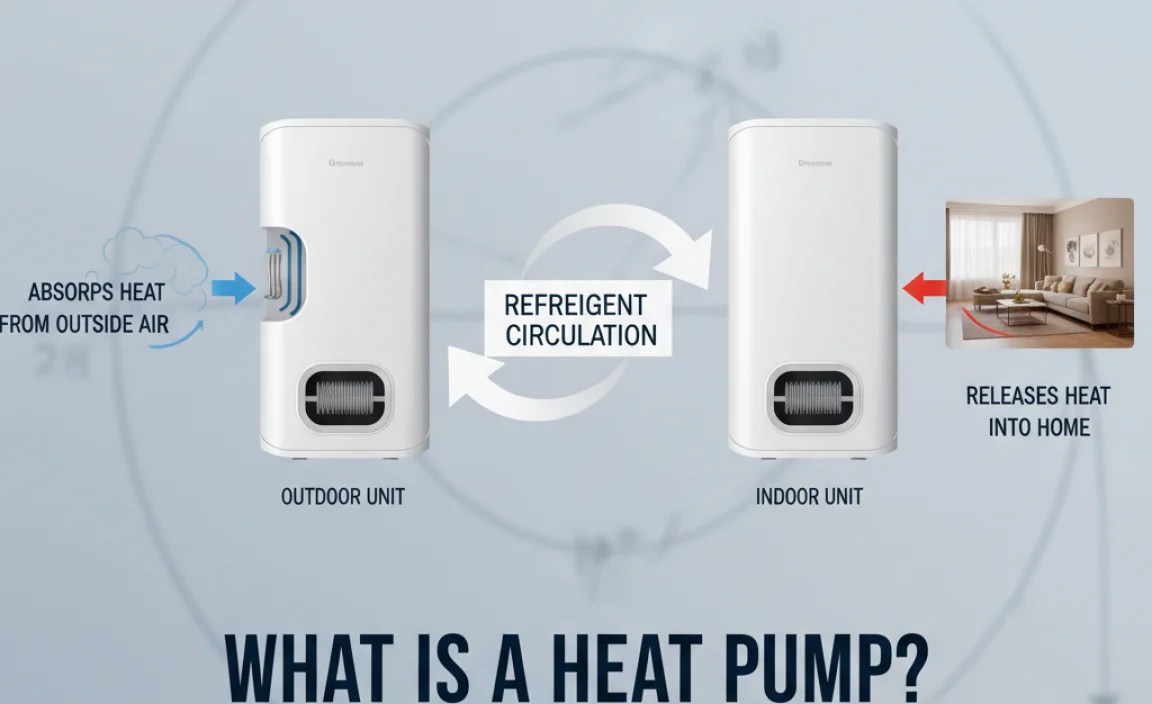
A heat pump is a device that transfers heat from a cold reservoir to a hot reservoir. Unlike a heat engine, it requires external work to operate. In simpler terms, it moves heat against its natural direction.
- Function: Transfers heat from a cold area to a hot area.
- Input: Requires mechanical work (usually electricity).
- Output: Provides heating or cooling.
- Examples: Refrigerators, air conditioners, geothermal heat pumps.
Heat pumps work by using a refrigerant that cycles through evaporation and condensation processes. Here’s how it works:
- Evaporation: The refrigerant absorbs heat from the cold reservoir and evaporates into a gas.
- Compression: The gas is compressed, increasing its temperature.
- Condensation: The hot gas releases heat to the hot reservoir and condenses back into a liquid.
- Expansion: The liquid refrigerant expands through an expansion valve, reducing its temperature and starting the cycle again.
The efficiency of a heat pump is measured by its Coefficient of Performance (COP), which is the ratio of heat transferred to the work required. A higher COP indicates a more efficient heat pump.
Heat Pump Applications
Heat pumps are incredibly versatile and used in a wide range of applications. Here are a few notable examples:
- Residential Heating and Cooling: Heat pumps can both heat and cool homes, making them a popular choice for energy-efficient climate control.
- Refrigeration: Refrigerators use heat pumps to keep the inside cold by transferring heat to the outside.
- Industrial Processes: Heat pumps are used in various industrial applications, such as drying, distillation, and waste heat recovery.
Geothermal heat pumps, for example, leverage the stable temperature of the earth to provide efficient heating and cooling. These systems circulate a refrigerant through underground pipes, using the earth as a heat source in winter and a heat sink in summer.
Key Differences: Heat Engine vs. Heat Pump
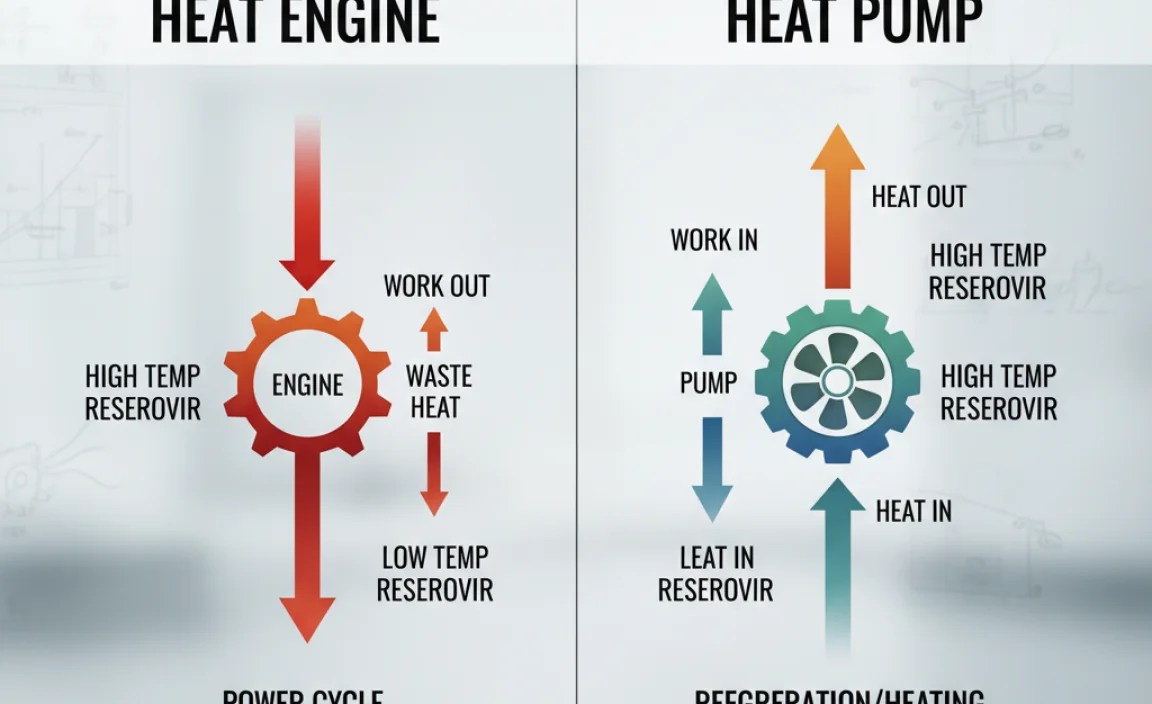
To make the distinction crystal clear, let’s look at the fundamental differences between heat engines and heat pumps in a table format:
| Feature | Heat Engine | Heat Pump |
|---|---|---|
| Function | Converts heat into work | Transfers heat from cold to hot |
| Energy Flow | Heat → Work | Work → Heat Transfer |
| Input | High-temperature heat source | Mechanical work |
| Output | Mechanical work | Heating or cooling |
| Natural Direction? | Follows natural heat flow | Opposes natural heat flow |
| Efficiency Metric | Thermal Efficiency | Coefficient of Performance (COP) |
| Examples | Car engines, power plants | Refrigerators, air conditioners |
As you can see, the core purpose and energy flow are completely different. A heat engine is all about turning heat into usable work, while a heat pump is about moving heat from one place to another, requiring work to do so.
The Underlying Principles: Thermodynamics
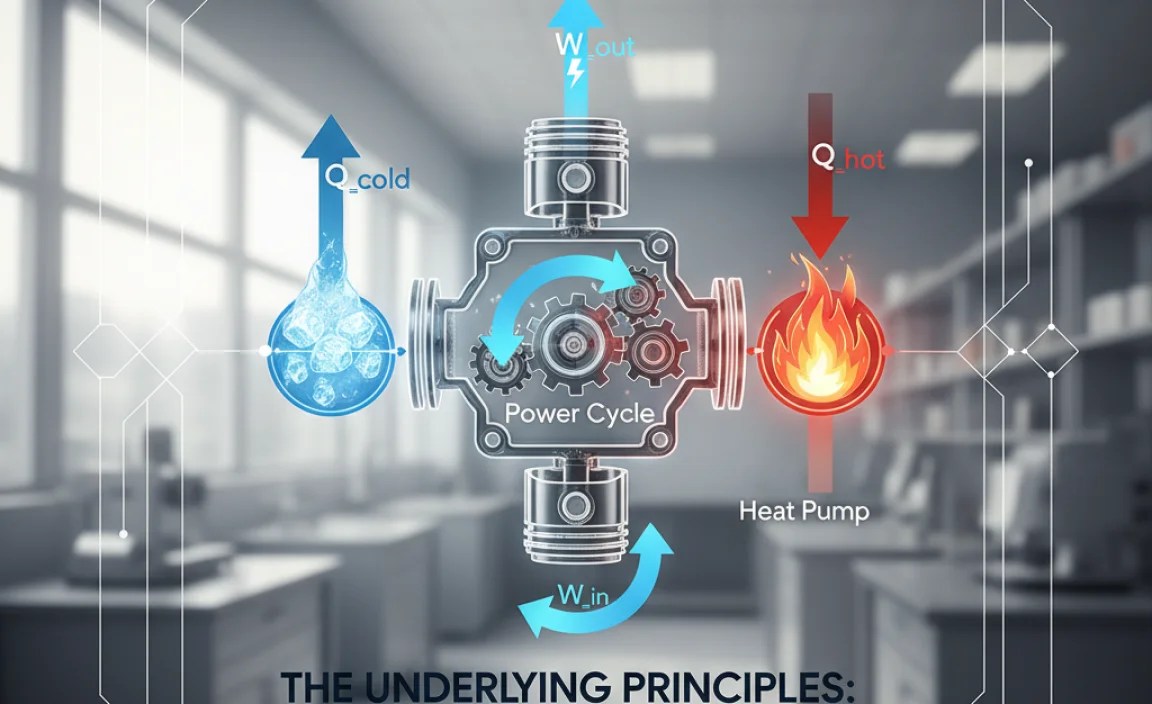
Both heat engines and heat pumps are governed by the laws of thermodynamics. Understanding these laws helps clarify how they function:
- First Law of Thermodynamics: Energy is conserved. In a heat engine, the heat input equals the work output plus the heat rejected. In a heat pump, the work input plus the heat absorbed from the cold reservoir equals the heat released to the hot reservoir.
- Second Law of Thermodynamics: Heat naturally flows from hot to cold. Heat engines use this natural flow to produce work. Heat pumps require work to reverse this natural flow.
The second law also introduces the concept of entropy, which is a measure of disorder in a system. Heat engines increase entropy by converting organized energy (heat) into less organized forms (work and waste heat). Heat pumps decrease entropy in one location (the hot reservoir) but increase it elsewhere (through the work input).
Real-World Examples
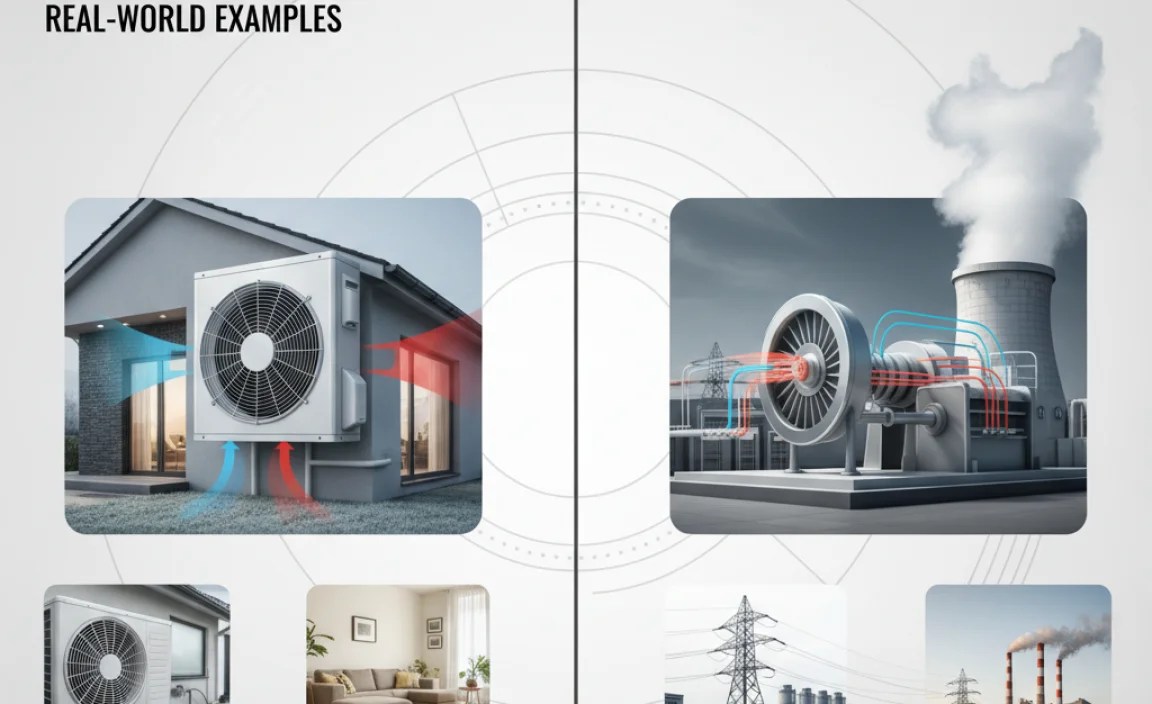
To solidify your understanding, let’s consider some everyday examples of heat engines and heat pumps.
Heat Engine Examples
- Internal Combustion Engine: Found in most cars, this engine burns fuel to produce heat, which then drives pistons to generate mechanical work.
- Steam Turbine: Used in power plants, steam turbines use high-pressure steam to turn a turbine, generating electricity. The steam is created by burning fossil fuels, nuclear reactions, or concentrated solar energy.
- Jet Engine: Jet engines use the combustion of fuel to heat air, which is then expelled to create thrust.
Heat Pump Examples
- Refrigerator: Refrigerators use a heat pump to remove heat from the inside compartment and release it to the surrounding environment, keeping the inside cold.
- Air Conditioner: Air conditioners transfer heat from inside a building to the outside, cooling the indoor air.
- Geothermal Heat Pump: These systems use the earth’s constant temperature to provide heating and cooling. In winter, they extract heat from the ground; in summer, they release heat into the ground.
Efficiency Considerations
When evaluating heat engines and heat pumps, efficiency is a critical factor. Here’s how efficiency is measured for each:
Heat Engine Efficiency
The thermal efficiency (\(\eta\)) of a heat engine is defined as the ratio of the net work output (\(W_{\text{net}}\)) to the heat input (\(Q_{\text{in}}\)):
\[
\eta = \frac{W_{\text{net}}}{Q_{\text{in}}}
\]
This value is always less than 1 (or 100%) because some heat is always rejected to the low-temperature reservoir, as dictated by the second law of thermodynamics. Carnot efficiency represents the theoretical maximum efficiency:
\[
\eta_{\text{Carnot}} = 1 – \frac{T_{\text{cold}}}{T_{\text{hot}}}
\]
Where \(T_{\text{cold}}\) and \(T_{\text{hot}}\) are the absolute temperatures of the cold and hot reservoirs, respectively.
Heat Pump Efficiency
The efficiency of a heat pump is measured by its Coefficient of Performance (COP). For heating, the COP is defined as the ratio of the heat delivered to the hot reservoir (\(Q_{\text{hot}}\)) to the work input (\(W_{\text{in}}\)):
\[
\text{COP}_{\text{heating}} = \frac{Q_{\text{hot}}}{W_{\text{in}}}
\]
For cooling, the COP is defined as the ratio of the heat removed from the cold reservoir (\(Q_{\text{cold}}\)) to the work input:
\[
\text{COP}_{\text{cooling}} = \frac{Q_{\text{cold}}}{W_{\text{in}}}
\]
The COP can be greater than 1, which means that the heat pump delivers more heat than the work it consumes. This is because it is simply moving heat, not creating it.
Future Trends and Innovations
The fields of heat engines and heat pumps are continuously evolving. Here are some notable trends and innovations:
- Improved Materials: Advances in materials science are leading to more efficient and durable engines and heat pumps.
- Waste Heat Recovery: Technologies that capture and reuse waste heat are becoming increasingly important for improving overall energy efficiency.
- Renewable Energy Integration: Heat pumps are being integrated with renewable energy sources like solar and geothermal to create sustainable heating and cooling solutions.
- Smart Controls: Smart thermostats and control systems optimize the operation of heat pumps to minimize energy consumption and maximize comfort.
For example, some researchers are exploring new refrigerants with lower global warming potential to reduce the environmental impact of heat pumps. Others are developing advanced engine designs that can operate at higher temperatures and pressures, increasing efficiency.
FAQ: Heat Engines and Heat Pumps
Here are some frequently asked questions to further clarify the concepts:
1. What is the main purpose of a heat engine?
A heat engine’s main purpose is to convert thermal energy (heat) into mechanical work. It takes heat from a high-temperature source and turns part of it into useful work, like powering a car or generating electricity.
2. How does a heat pump differ from a heat engine?
A heat pump moves heat from a cold area to a hot area, requiring external work to operate. A heat engine, on the other hand, converts heat into work. They have opposite functions.
3. Can a heat pump create heat?
No, a heat pump does not create heat. It transfers heat from one place to another. It moves heat from a cold source to a hot sink, using work to overcome the natural flow of heat.
4. What is COP in the context of heat pumps?
COP stands for Coefficient of Performance. It measures the efficiency of a heat pump by indicating the ratio of heat transferred to the work required. A higher COP means the heat pump is more efficient.
5. Why is the Carnot cycle important?
The Carnot cycle is a theoretical ideal that represents the maximum possible efficiency for a heat engine operating between two temperatures. It serves as a benchmark for real-world engines, even though they can’t achieve it due to practical limitations.
6. Are heat pumps only used for heating?
No, heat pumps can be used for both heating and cooling. In the heating mode, they transfer heat from the outside to the inside. In the cooling mode, they reverse the process, transferring heat from the inside to the outside.
7. What are some examples of renewable energy integration with heat pumps?
Heat pumps can be integrated with solar thermal systems to provide heat or with geothermal systems to leverage the earth’s stable temperature. These combinations create sustainable heating and cooling solutions.
Conclusion
Understanding the difference between heat engines and heat pumps is key to grasping the fundamentals of thermodynamics. A heat engine converts heat into work, while a heat pump transfers heat from a cold reservoir to a hot reservoir, requiring work to operate. While they both deal with heat and are governed by the laws of thermodynamics, their functions and applications are quite distinct. Whether it’s the engine in your car or the refrigerator in your kitchen, these principles are at work all around us, shaping the way we use and manage energy.
“`


