
How Much Potassium and Sodium Are Transported Per Pump Cycle?

Quick Summary: The sodium-potassium pump transports 3 sodium ions (Na+) out of the cell and 2 potassium ions (K+) into the cell during each cycle. This process maintains the electrochemical gradient essential for nerve impulses, muscle contractions, and nutrient transport.
Ever wondered how your muscles contract, your nerves fire, and your body absorbs nutrients? It all comes down to tiny molecular pumps working tirelessly in your cells. One of the most important is the sodium-potassium pump. It’s responsible for maintaining the right balance of sodium and potassium ions across your cell membranes. This balance is crucial for many bodily functions, and understanding how this pump works can help you appreciate the complexity of your body. Don’t worry, we’ll break it down step by step! This article will explain exactly how much potassium and sodium are transported per pump cycle and why it matters.
Understanding the Sodium-Potassium Pump

The sodium-potassium pump, also known as Na+/K+ ATPase, is a protein found in the cell membrane of all animal cells. It’s an active transport protein, meaning it uses energy (in the form of ATP) to move ions against their concentration gradients. Think of it as a tiny engine constantly working to keep the levels of sodium and potassium just right inside and outside your cells.
To fully grasp how much potassium and sodium are transported per pump cycle, it’s essential to understand the underlying principles of this pump.
Why is the Sodium-Potassium Pump Important?
The sodium-potassium pump plays several vital roles in maintaining cell function and overall health:
- Maintaining Cell Volume: By controlling the concentration of ions inside and outside the cell, the pump helps prevent cells from swelling or shrinking due to osmosis.
- Nerve Impulse Transmission: The electrochemical gradient created by the pump is essential for nerve cells to generate and transmit electrical signals. This is how your brain communicates with the rest of your body.
- Muscle Contraction: The pump helps maintain the ion balance needed for muscles to contract properly.
- Nutrient Transport: The sodium gradient created by the pump is used by other transport proteins to move nutrients like glucose and amino acids into the cell.
The Electrochemical Gradient
The sodium-potassium pump creates an electrochemical gradient across the cell membrane. This gradient is a difference in both electrical charge and ion concentration. Here’s what that means:
- Electrical Gradient: The inside of the cell is more negative compared to the outside due to the unequal movement of sodium and potassium ions.
- Concentration Gradient: There is a higher concentration of sodium ions (Na+) outside the cell and a higher concentration of potassium ions (K+) inside the cell.
This gradient is a form of potential energy that the cell can use to perform various functions. It’s like a battery that powers many cellular processes.
The Pumping Process: Step-by-Step
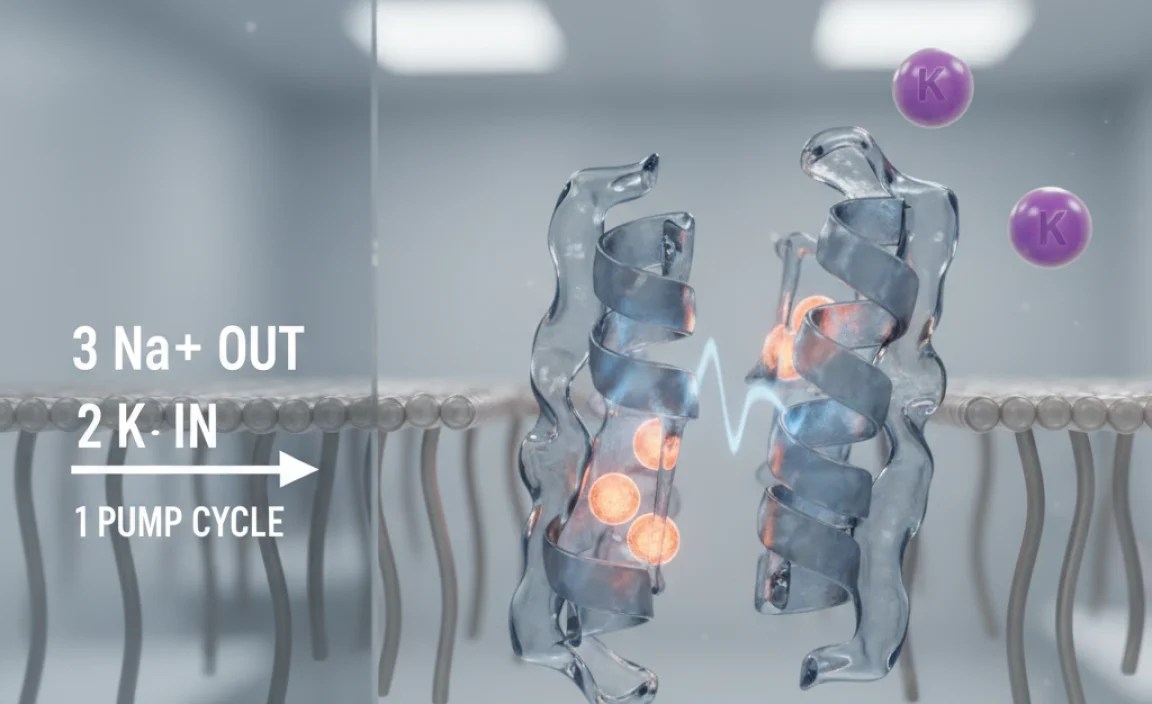
The sodium-potassium pump operates in a cycle, and each cycle involves several steps. Understanding these steps will clarify exactly how much potassium and sodium are transported per pump cycle.
- Binding of Sodium Ions: The pump starts with the binding of three sodium ions (Na+) from inside the cell to specific binding sites on the pump protein.
- ATP Hydrolysis: A molecule of ATP (adenosine triphosphate) is split (hydrolyzed) into ADP (adenosine diphosphate) and a phosphate group. The phosphate group binds to the pump. This process provides the energy needed for the pump to change shape.
- Shape Change and Sodium Release: The pump changes shape, which causes it to release the three sodium ions (Na+) outside the cell.
- Binding of Potassium Ions: Two potassium ions (K+) from outside the cell bind to the pump.
- Phosphate Release: The phosphate group is released from the pump.
- Shape Change and Potassium Release: The pump returns to its original shape, causing it to release the two potassium ions (K+) inside the cell. The cycle is now ready to start again.
Here’s a table summarizing the steps:
| Step | Event | Location | Ions Involved |
|---|---|---|---|
| 1 | Binding of Sodium Ions | Inside the cell | 3 Na+ |
| 2 | ATP Hydrolysis | Pump Protein | ATP → ADP + Phosphate |
| 3 | Shape Change and Sodium Release | Outside the cell | 3 Na+ released |
| 4 | Binding of Potassium Ions | Outside the cell | 2 K+ |
| 5 | Phosphate Release | Pump Protein | Phosphate released |
| 6 | Shape Change and Potassium Release | Inside the cell | 2 K+ released |
Quantifying the Transport: How Much Sodium and Potassium?

So, how much potassium and sodium are transported per pump cycle? Let’s break it down:
- Sodium (Na+): For each cycle, the sodium-potassium pump transports three sodium ions (3 Na+) out of the cell.
- Potassium (K+): Simultaneously, the pump transports two potassium ions (2 K+) into the cell.
This 3:2 ratio is crucial for maintaining the electrochemical gradient. The unequal transport of ions contributes to the negative charge inside the cell relative to the outside.
Why This Ratio Matters
The 3:2 ratio of sodium to potassium transport is not arbitrary. It’s carefully designed to create and maintain the necessary electrochemical gradient for various cellular functions.
- Nerve Function: The negative resting membrane potential in nerve cells is largely due to this unequal transport. This potential is essential for the rapid depolarization and repolarization needed for nerve impulse transmission.
- Muscle Function: In muscle cells, the sodium-potassium pump helps maintain the ion balance needed for muscle contraction and relaxation. Disruptions in this balance can lead to muscle cramps or weakness.
- Kidney Function: In the kidneys, the pump plays a critical role in reabsorbing sodium and maintaining fluid balance in the body.
Factors Affecting Pump Activity
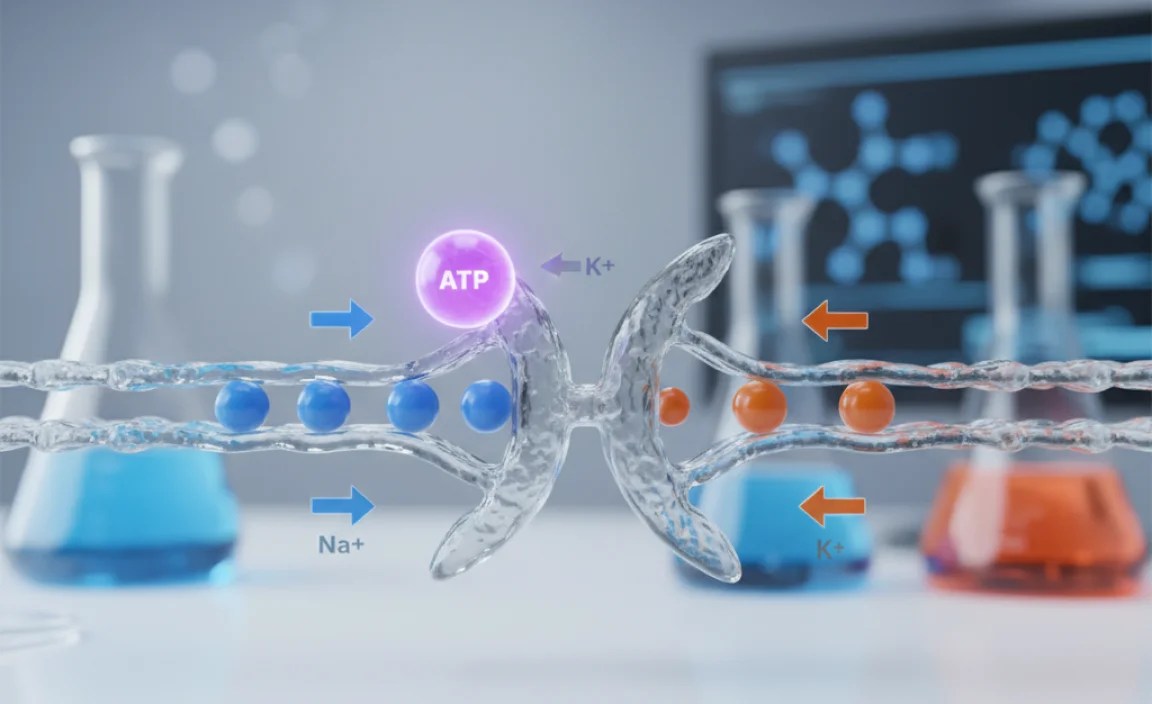
Several factors can influence the activity of the sodium-potassium pump. Understanding these factors can provide insights into conditions that might affect its function.
- ATP Availability: The pump requires ATP to function, so anything that reduces ATP production can decrease pump activity. Conditions like hypoxia (low oxygen) or metabolic disorders can affect ATP levels.
- Ion Concentrations: The concentrations of sodium and potassium inside and outside the cell can influence the pump’s activity. Extreme imbalances can impair its function.
- Temperature: Like most enzymes, the sodium-potassium pump is sensitive to temperature. Extreme temperatures can reduce its activity.
- Inhibitors: Certain substances can inhibit the pump. For example, ouabain, a cardiac glycoside, is a known inhibitor. This drug is sometimes used to treat heart conditions, but it must be used carefully because it can disrupt ion balance.
Common Inhibitors of the Sodium-Potassium Pump
Certain substances can inhibit the sodium-potassium pump, disrupting its normal function. Here are some common examples:
- Ouabain: A cardiac glycoside used in some heart medications. It binds to the pump and prevents it from functioning properly.
- Digoxin: Another cardiac glycoside with similar effects to ouabain.
- Vanadate: A compound that can interfere with the phosphate binding site on the pump.
Understanding these inhibitors is crucial in pharmacology and medicine, as they can have significant effects on cellular function and overall health.
Clinical Significance of the Sodium-Potassium Pump

The sodium-potassium pump is crucial for maintaining cellular function, and disruptions in its activity can lead to various clinical conditions. Understanding these conditions highlights the pump’s importance in human health.
Conditions Related to Pump Dysfunction
- Heart Failure: Cardiac glycosides like digoxin are used to treat heart failure by inhibiting the sodium-potassium pump in heart muscle cells. This increases the force of heart contractions.
- Hypertension: The pump plays a role in regulating blood pressure. Dysfunction can contribute to hypertension (high blood pressure).
- Kidney Disease: The pump is essential for kidney function. Kidney diseases can impair the pump’s activity, leading to electrolyte imbalances.
- Neurological Disorders: Disruptions in the pump’s activity can affect nerve function and contribute to neurological disorders.
Maintaining the proper function of the sodium-potassium pump is essential for overall health, and understanding its role can provide insights into various medical conditions.
The Pump in Different Cell Types
The sodium-potassium pump operates in all animal cells, but its specific function and importance can vary depending on the cell type.
Nerve Cells (Neurons)
In neurons, the sodium-potassium pump is crucial for maintaining the resting membrane potential and for the repolarization phase after an action potential. This allows neurons to rapidly transmit electrical signals. The pump ensures that the neuron is ready to fire again by restoring the ion gradients.
Muscle Cells
In muscle cells, the pump helps maintain the ion balance needed for muscle contraction and relaxation. It ensures that the muscle cells can respond quickly to nerve signals and contract properly. Disruptions in the pump’s activity can lead to muscle cramps or weakness.
Kidney Cells
In kidney cells, the pump plays a vital role in reabsorbing sodium and maintaining fluid balance in the body. It helps regulate blood volume and blood pressure. The pump’s activity in the kidneys is tightly controlled to maintain homeostasis.
Red Blood Cells
Even in red blood cells, which lack many organelles, the sodium-potassium pump is present. It helps maintain cell volume and prevent swelling or shrinking. This is essential for the proper function of red blood cells in oxygen transport.
The Future of Sodium-Potassium Pump Research
Research on the sodium-potassium pump continues to evolve, with new insights into its structure, function, and regulation. Here are some areas of ongoing research:
- Drug Development: Researchers are exploring new drugs that can target the sodium-potassium pump to treat various conditions, including heart failure and hypertension.
- Structural Biology: Advances in structural biology are providing detailed views of the pump’s structure, which can help scientists understand how it works at the molecular level.
- Regulation: Scientists are studying how the pump’s activity is regulated by various factors, including hormones and intracellular signaling pathways.
These research efforts promise to provide a deeper understanding of the sodium-potassium pump and its role in human health and disease.
FAQ About the Sodium-Potassium Pump
1. What is the main function of the sodium-potassium pump?
The main function is to maintain the electrochemical gradient across the cell membrane by transporting sodium ions out of the cell and potassium ions into the cell.
2. How many sodium and potassium ions are transported per cycle?
For each cycle, 3 sodium ions (Na+) are transported out of the cell, and 2 potassium ions (K+) are transported into the cell.
3. What energy source does the sodium-potassium pump use?
The pump uses ATP (adenosine triphosphate) as its energy source. ATP is hydrolyzed to ADP and phosphate, providing the energy needed for the pump to change shape and move ions against their concentration gradients.
4. Why is the sodium-potassium pump important for nerve cells?
It is crucial for maintaining the resting membrane potential and for the repolarization phase after an action potential, allowing neurons to rapidly transmit electrical signals.
5. What happens if the sodium-potassium pump stops working?
If the pump stops working, the ion balance across the cell membrane is disrupted, which can lead to various problems, including cell swelling, nerve dysfunction, muscle weakness, and kidney problems.
6. Can drugs affect the sodium-potassium pump?
Yes, certain drugs like cardiac glycosides (e.g., digoxin and ouabain) can inhibit the pump, affecting its function. These drugs are sometimes used to treat heart conditions but must be used carefully.
7. Where is the sodium-potassium pump located?
The sodium-potassium pump is located in the cell membrane of all animal cells, where it plays a vital role in maintaining cellular function and overall health.
Conclusion
Understanding how much potassium and sodium are transported per pump cycle is essential for appreciating the complexity and importance of this cellular mechanism. The sodium-potassium pump diligently moves 3 sodium ions out and 2 potassium ions in, creating the electrochemical gradient that powers nerve impulses, muscle contractions, and nutrient transport. By understanding the pump’s function, the factors that affect its activity, and its clinical significance, you can gain a deeper appreciation for the intricate processes that keep your body running smoothly. So, the next time you’re out on a bike ride, remember the tiny sodium-potassium pumps working hard in your cells, keeping you powered and balanced!
“`


