
Understanding How a Heat Pump Operates on a Carnot Cycle

Quick Summary: A heat pump moves heat from a cooler place to a warmer one, using a refrigerant that cycles through evaporation and condensation. While real-world heat pumps don’t perfectly follow the ideal Carnot cycle due to factors like friction and imperfect heat transfer, understanding the Carnot cycle helps us grasp the theoretical limits of a heat pump’s efficiency. It gives us a benchmark for how well our heat pumps are performing.
Ever wondered how a heat pump keeps your home cozy in the winter and cool in the summer? It might seem like magic, but it’s all based on some pretty cool science! At its heart, a heat pump works by moving heat from one place to another. The Carnot cycle is a theoretical model that helps us understand the best possible efficiency a heat pump can achieve. While real-world heat pumps aren’t perfect, knowing about the Carnot cycle gives us a great way to understand how these systems work and how to improve them. Let’s dive in!
What is a Carnot Cycle?

The Carnot cycle is a theoretical thermodynamic cycle that represents the most efficient possible way to convert heat into work, or, in the case of a heat pump, to move heat from a cold reservoir to a hot reservoir. It’s like the perfect blueprint for how a heat engine or heat pump could work, even though real-world machines can’t quite reach that level of perfection. It’s named after Nicolas Léonard Sadi Carnot, a French military engineer who described it in 1824.
The Carnot cycle consists of four reversible processes:
- Isothermal Expansion: The working fluid (refrigerant in a heat pump) absorbs heat at a constant high temperature and expands.
- Adiabatic Expansion: The fluid continues to expand, but without any heat exchange with the surroundings, causing it to cool.
- Isothermal Compression: The fluid releases heat at a constant low temperature and is compressed.
- Adiabatic Compression: The fluid is further compressed without any heat exchange, causing its temperature to rise back to the starting point.
The Carnot Cycle and Heat Pumps: A Closer Look

A heat pump essentially runs the Carnot cycle in reverse. Instead of converting heat into work, it uses work (electrical energy) to move heat from a cold space to a hot space. This is why you can use a heat pump to heat your home even when it’s cold outside – it’s extracting heat from the outside air (or ground) and pumping it inside.
Here’s how each stage of the Carnot cycle relates to the operation of a heat pump:
- Evaporation (Isothermal Expansion): The refrigerant absorbs heat from the cold source (outside air or ground) and evaporates into a gas at a low temperature.
- Compression (Adiabatic Compression): The refrigerant gas is compressed, which increases its temperature. This requires work input from the compressor.
- Condensation (Isothermal Compression): The hot refrigerant gas releases heat to the hot sink (inside your home) and condenses back into a liquid at a high temperature.
- Expansion (Adiabatic Expansion): The high-pressure liquid refrigerant expands through an expansion valve, which reduces its pressure and temperature, preparing it to absorb more heat in the evaporator.
Components of a Heat Pump

To better understand how a heat pump works, let’s look at the key components:
- Evaporator: This is where the refrigerant absorbs heat from the cold source and evaporates.
- Compressor: This increases the pressure and temperature of the refrigerant gas.
- Condenser: This is where the refrigerant releases heat to the hot sink and condenses.
- Expansion Valve: This reduces the pressure and temperature of the liquid refrigerant.
- Refrigerant: The working fluid that circulates through the system, absorbing and releasing heat.
Coefficient of Performance (COP)
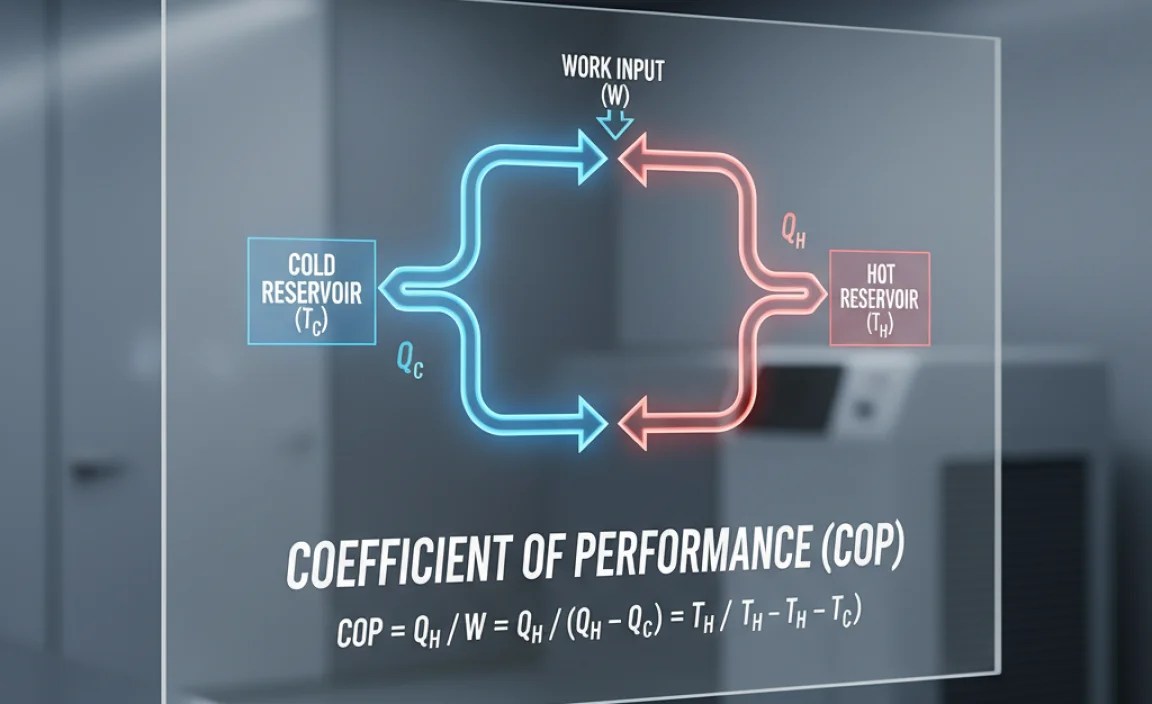
The efficiency of a heat pump is measured by its Coefficient of Performance (COP). The COP is the ratio of the heat delivered to the hot reservoir (heating) or removed from the cold reservoir (cooling) to the work required to operate the heat pump.
COP = (Heat Delivered or Removed) / (Work Input)
A higher COP indicates a more efficient heat pump. The Carnot cycle provides the theoretical maximum COP for a heat pump operating between two temperatures. However, real-world heat pumps always have a lower COP due to inefficiencies like friction, heat loss, and imperfect heat exchangers.
Carnot Efficiency vs. Real-World Efficiency
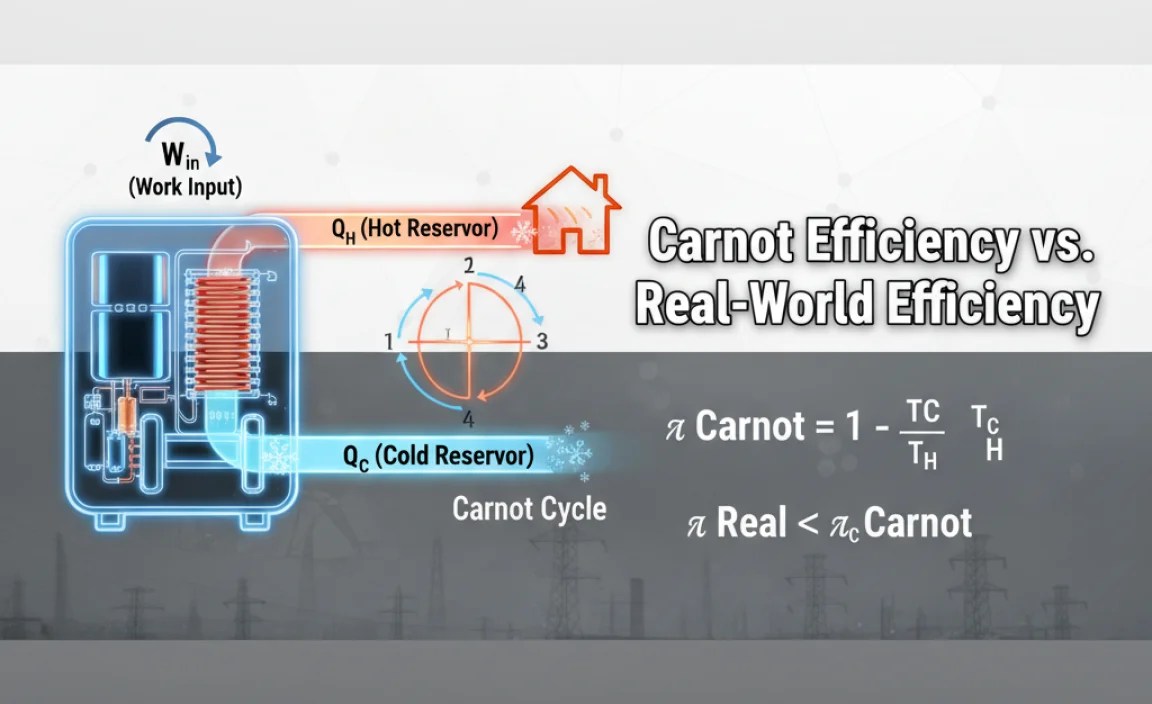
The Carnot efficiency sets the upper limit for any heat engine or heat pump. The Carnot COP for a heat pump is calculated as:
COPCarnot = TH / (TH – TC)
Where:
- TH is the absolute temperature (in Kelvin or Rankine) of the hot reservoir.
- TC is the absolute temperature of the cold reservoir.
Notice that the smaller the temperature difference between the hot and cold reservoirs, the higher the Carnot COP. This means that heat pumps are more efficient when the temperature difference is small – for example, when heating your home on a mild winter day compared to a very cold day.
Real-world heat pumps have lower COP values than the Carnot COP due to various factors:
- Friction: Friction in the compressor and other moving parts generates heat, which reduces efficiency.
- Heat Loss: Heat can be lost to the surroundings through the walls of the heat pump components.
- Imperfect Heat Exchangers: Heat exchangers (evaporator and condenser) are not perfectly efficient at transferring heat.
- Non-Ideal Gas Behavior: Real refrigerants don’t behave exactly like ideal gases, which affects the thermodynamic cycle.
- Temperature Glides: Some refrigerants exhibit temperature glides during phase changes, which deviate from the isothermal processes assumed in the Carnot cycle.
Manufacturers are constantly working to improve the efficiency of heat pumps by minimizing these losses and using more efficient components and refrigerants. However, they can never completely eliminate these losses, so real-world heat pumps will always fall short of the Carnot efficiency.
Why is the Carnot Cycle Important?
Even though real-world heat pumps can’t achieve Carnot efficiency, the Carnot cycle is still incredibly valuable for several reasons:
- Theoretical Limit: It provides a benchmark for the maximum possible efficiency of a heat pump operating between two temperatures. This helps engineers understand the potential for improvement and set realistic goals.
- Design Optimization: Understanding the Carnot cycle helps engineers identify the areas where losses are occurring and focus on improving those aspects of the design.
- Performance Evaluation: The Carnot COP can be used to compare the performance of different heat pumps and evaluate how close they are to the theoretical maximum.
- Refrigerant Selection: The properties of the refrigerant can significantly impact the efficiency of a heat pump. The Carnot cycle helps engineers understand how different refrigerants will perform under different conditions.
Types of Heat Pumps
While the underlying principle of the Carnot cycle remains the same, heat pumps come in different types, each with its own advantages and disadvantages:
- Air-Source Heat Pumps: These are the most common type of heat pump. They transfer heat between the indoor air and the outdoor air. They are relatively inexpensive to install, but their efficiency can decrease in very cold weather.
- Ground-Source Heat Pumps (Geothermal): These heat pumps transfer heat between the indoor air and the ground. The ground temperature remains relatively constant throughout the year, so ground-source heat pumps are more efficient than air-source heat pumps, especially in extreme climates. However, they are more expensive to install.
- Water-Source Heat Pumps: These heat pumps transfer heat between the indoor air and a body of water, such as a lake or well. They are similar to ground-source heat pumps in terms of efficiency and cost.
- Absorption Heat Pumps: These heat pumps use a heat source, such as natural gas or solar energy, to drive the thermodynamic cycle instead of electricity. They are less common than vapor-compression heat pumps but can be a good option in certain applications.
Factors Affecting Heat Pump Efficiency
Several factors can affect the efficiency of a heat pump, including:
- Temperature Difference: As mentioned earlier, the smaller the temperature difference between the hot and cold reservoirs, the higher the efficiency.
- Refrigerant Type: Different refrigerants have different thermodynamic properties, which can affect the efficiency of the heat pump.
- Compressor Efficiency: The efficiency of the compressor is a major factor in the overall efficiency of the heat pump.
- Heat Exchanger Design: The design of the evaporator and condenser can impact their ability to transfer heat efficiently.
- Insulation: Proper insulation can reduce heat loss and improve the overall efficiency of the system.
- Maintenance: Regular maintenance, such as cleaning the coils and replacing filters, can help keep the heat pump running efficiently.
Tips for Improving Heat Pump Efficiency
Here are some tips to help you get the most out of your heat pump:
- Set the Thermostat Strategically: Avoid setting the thermostat too high or too low, as this can reduce efficiency.
- Use a Programmable Thermostat: Program the thermostat to automatically adjust the temperature when you are away or asleep.
- Keep the Coils Clean: Clean the outdoor and indoor coils regularly to ensure proper airflow.
- Change the Air Filter: Replace the air filter regularly to maintain good airflow and prevent dust buildup.
- Seal Air Leaks: Seal any air leaks around windows, doors, and other openings to prevent heat loss.
- Insulate Your Home: Proper insulation can significantly reduce heat loss and improve the efficiency of your heat pump.
- Consider a Smart Thermostat: Smart thermostats can learn your heating and cooling patterns and automatically adjust the temperature for optimal efficiency.
Heat Pump Maintenance Checklist
Regular maintenance is key to keeping your heat pump running efficiently and extending its lifespan. Here’s a simple checklist:
- Monthly:
- Check and replace air filters.
- Quarterly:
- Inspect outdoor unit for debris and clean as needed.
- Check for unusual noises or vibrations.
- Annually:
- Schedule a professional inspection and tune-up.
- Check refrigerant levels.
- Inspect and clean coils.
- Lubricate moving parts.
Pros and Cons of Heat Pumps
Heat pumps offer several advantages over traditional heating and cooling systems:
Pros:
- High Efficiency: Heat pumps can be much more efficient than traditional furnaces and air conditioners.
- Versatile: Heat pumps can provide both heating and cooling.
- Environmentally Friendly: Heat pumps use electricity instead of fossil fuels, which can reduce greenhouse gas emissions.
- Reduced Carbon Footprint: Because of their efficiency, heat pumps can shrink your overall environmental impact.
Cons:
- Higher Upfront Cost: Heat pumps can be more expensive to install than traditional systems.
- Reduced Efficiency in Cold Weather: Air-source heat pumps can lose efficiency in very cold weather.
- Requires Electricity: Heat pumps rely on electricity, so they won’t work during a power outage unless you have a backup generator.
Real-World Example: Heat Pump Installation Costs
To give you a better idea, here’s a table showing typical heat pump installation costs:
| Type of Heat Pump | Average Installation Cost | Efficiency (HSPF/SEER) |
|---|---|---|
| Air-Source Heat Pump | $4,000 – $8,000 | 8-10 HSPF / 14-20 SEER |
| Geothermal Heat Pump | $15,000 – $30,000 | 10-12 HSPF / 20-30 SEER |
Note: Costs can vary depending on location, size of the home, and other factors. HSPF stands for Heating Season Performance Factor, and SEER stands for Seasonal Energy Efficiency Ratio.
Heat Pump vs. Traditional HVAC Systems
Deciding whether to go with a heat pump or stick with traditional HVAC (Heating, Ventilation, and Air Conditioning) systems depends on your specific needs and circumstances. Here’s a quick comparison:
| Feature | Heat Pump | Traditional HVAC |
|---|---|---|
| Efficiency | Higher, especially in moderate climates | Lower |
| Fuel Source | Electricity | Natural gas, propane, or oil |
| Heating and Cooling | Both in one unit | Separate units for heating and cooling |
| Environmental Impact | Lower, if electricity is from renewable sources | Higher |
| Upfront Cost | Can be higher | Generally lower |
| Operating Cost | Often lower in the long run | Can be higher, depending on fuel prices |
FAQ About Heat Pumps and the Carnot Cycle
Q: Does a heat pump really use a Carnot cycle?
A: While the ideal heat pump operation is based on the Carnot cycle, real-world heat pumps don’t perfectly replicate it due to inefficiencies like friction and imperfect heat transfer. However, the Carnot cycle provides a theoretical benchmark for efficiency.
Q: What is COP, and why is it important?
A: COP stands for Coefficient of Performance. It’s a measure of a heat pump’s efficiency, calculated as the ratio of heat delivered to work required. A higher COP means greater efficiency and lower operating costs.
Q: Are heat pumps effective in very cold climates?
A: Air-source heat pumps can lose efficiency in very cold climates. Ground-source heat pumps are generally more effective in these conditions because the ground temperature remains relatively constant.
Q: How can I improve the efficiency of my heat pump?
A: You can improve efficiency by setting the thermostat strategically, using a programmable thermostat, keeping the coils clean, changing the air filter regularly, sealing air leaks, and insulating your home.
Q: What are the different types of heat pumps?
A: The main types are air-source, ground-source (geothermal), and water-source heat pumps. Air-source heat pumps are the most common, while ground-source heat pumps are generally more efficient.
Q: How often should I maintain my heat pump?
A: You should check and replace air filters monthly, inspect the outdoor unit quarterly, and schedule a professional inspection and tune-up annually.
Q: Is a heat pump a good investment?
A: It depends on your climate, energy costs, and upfront budget. Heat pumps can be a great long-term investment due to their high efficiency and versatility, but consider the upfront cost and potential savings over time.
Conclusion
Understanding how a heat pump operates on the principles of the Carnot cycle can seem a bit complex at first, but hopefully, this guide has made it clearer. While real-world heat pumps don’t achieve the perfect efficiency of the Carnot cycle, knowing the theoretical limits helps us appreciate the technology and strive for improvements. By maintaining your heat pump, optimizing its settings, and understanding its capabilities, you can enjoy efficient and comfortable heating and cooling for years to come. So, next time you feel that cozy warmth on a cold day, remember the science of heat transfer and the ingenious engineering behind your heat pump!
“`


