
What Does Via Pumping Mean in Water Cycle? Find Out!

“`html
What Does Via Pumping Mean in the Water Cycle? A Simple Guide
Via pumping in the water cycle refers to the human intervention of moving water from one place to another using pumps. This process significantly impacts water distribution, availability, and can have both positive and negative environmental consequences. It’s essential to understand via pumping to appreciate how humans influence and manage our planet’s most precious resource.
Ever wondered how cities get their water? Or how farmers irrigate their fields? Chances are, pumps play a huge role. Via pumping is a fancy way of saying humans use technology to move water where it’s needed. But it’s not as simple as just turning on a tap. This movement of water affects everything from our ecosystems to our climate. Let’s dive into what via pumping means and why it’s so important.
Understanding the Water Cycle Basics
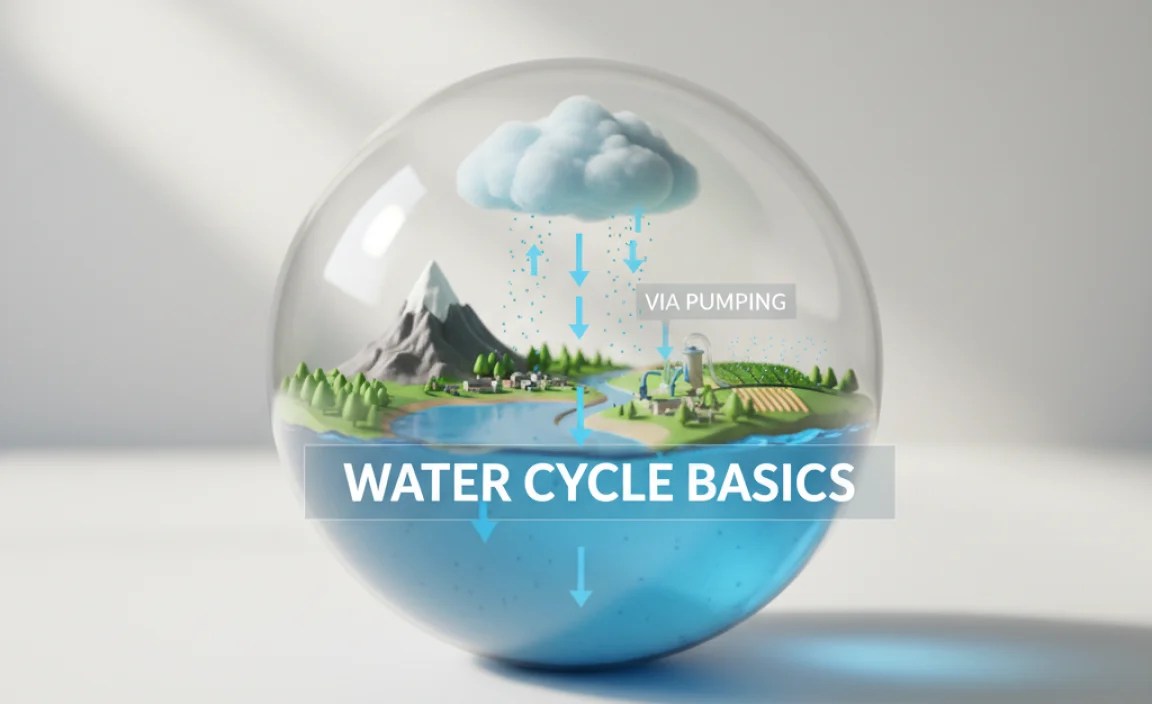
Before we get into the nitty-gritty of via pumping, let’s quickly recap the natural water cycle. The water cycle, also known as the hydrologic cycle, describes the continuous movement of water on, above, and below the surface of the Earth. Here’s a simplified breakdown:
- Evaporation: The sun heats up water in lakes, rivers, and oceans, turning it into vapor that rises into the atmosphere.
- Transpiration: Plants release water vapor into the air through their leaves.
- Condensation: As water vapor rises, it cools and turns back into liquid, forming clouds.
- Precipitation: When clouds become too heavy, water falls back to Earth as rain, snow, sleet, or hail.
- Collection: Water accumulates in rivers, lakes, and oceans, or soaks into the ground, becoming groundwater.
This cycle naturally distributes water around the globe, but it doesn’t always match human needs. That’s where via pumping comes in.
What is Via Pumping?
Via pumping is the process of using mechanical pumps to move water from one location to another. This human intervention in the natural water cycle is crucial for various reasons, including:
- Water Supply: Providing drinking water to cities and towns.
- Irrigation: Supplying water to agricultural fields for crop production.
- Industrial Use: Providing water for manufacturing and other industrial processes.
- Flood Control: Draining excess water from flooded areas.
- Wastewater Management: Moving wastewater to treatment plants.
Pumps can move water over long distances, uphill, and against gravity, making it possible to access water resources that would otherwise be unavailable. They are a vital part of modern infrastructure.
Types of Pumps Used in the Water Cycle

Different types of pumps are used depending on the specific application and the characteristics of the water source. Here are some common types:
- Centrifugal Pumps: These are the most common type, using a rotating impeller to increase the water’s velocity and pressure. They’re used in municipal water supplies, irrigation, and industrial processes.
- Submersible Pumps: Designed to be submerged in water, these pumps are often used in wells, boreholes, and for dewatering construction sites.
- Positive Displacement Pumps: These pumps deliver a fixed amount of water with each stroke or rotation, making them suitable for applications requiring precise flow rates, such as chemical dosing in water treatment.
- Jet Pumps: These pumps use a jet of water or air to create suction and draw water into the pump. They’re often used in shallow wells.
- Axial-Flow Pumps: These pumps move water along a straight axis, making them suitable for high-volume, low-head applications like flood control and irrigation.
Each type of pump has its advantages and disadvantages, and the selection depends on factors such as flow rate, head (the height the water needs to be lifted), and the properties of the water being pumped. Understanding these differences is crucial for efficient water management.
The Impact of Via Pumping on the Water Cycle

Via pumping significantly alters the natural water cycle, with both positive and negative consequences. Let’s explore some of these impacts:
Positive Impacts
- Reliable Water Supply: Pumps ensure a consistent and reliable water supply for domestic, agricultural, and industrial use, even in areas with limited natural water resources.
- Increased Agricultural Productivity: Irrigation through pumping enables farmers to grow crops in arid and semi-arid regions, increasing food production and supporting livelihoods.
- Flood Control: Pumps can quickly remove excess water from flooded areas, reducing damage to property and infrastructure.
- Improved Sanitation: Wastewater pumping systems ensure the safe removal and treatment of sewage, protecting public health and the environment.
Negative Impacts
- Groundwater Depletion: Over-pumping of groundwater can lead to depletion of aquifers, reducing water availability for future generations and causing land subsidence (sinking). The USGS has extensive resources on groundwater depletion.
- Ecosystem Disruption: Diverting water from rivers and lakes can harm aquatic ecosystems, affecting fish populations, wetland habitats, and water quality.
- Energy Consumption: Pumping water requires energy, contributing to greenhouse gas emissions and climate change, especially if the energy source is fossil fuels.
- Water Quality Degradation: Pumping can mobilize contaminants in groundwater, such as arsenic or saltwater, leading to water quality problems.
The key to sustainable water management is to minimize the negative impacts of via pumping while maximizing its benefits. This requires careful planning, efficient technology, and responsible water use practices.
Examples of Via Pumping in Action

To better understand via pumping, let’s look at some real-world examples:
- The Central Valley Project (California): This massive project uses a network of dams, canals, and pumps to transfer water from the Sacramento River in Northern California to the arid San Joaquin Valley in the south, supporting agriculture and urban development. However, it has also led to significant environmental impacts, including reduced flows in the Sacramento-San Joaquin Delta.
- The Great Man-Made River (Libya): This ambitious project pumps groundwater from deep aquifers in the Sahara Desert to coastal cities, providing drinking water and supporting agriculture. However, it raises concerns about the long-term sustainability of the aquifers and the potential for land subsidence.
- The Netherlands: A country largely below sea level, the Netherlands relies heavily on pumps to drain water from polders (reclaimed land) and protect against flooding. This requires a sophisticated system of pumping stations and water management infrastructure.
These examples illustrate the scale and complexity of via pumping projects, as well as the challenges of balancing water needs with environmental sustainability.
How to Reduce the Environmental Impact of Via Pumping
Given the significant impacts of via pumping, it’s crucial to adopt strategies to minimize its environmental footprint. Here are some key approaches:
- Improve Pumping Efficiency: Use energy-efficient pumps and optimize pumping schedules to reduce energy consumption and greenhouse gas emissions. Regularly maintain pumps to ensure they are operating at peak performance.
- Implement Water Conservation Measures: Reduce water demand through efficient irrigation techniques (e.g., drip irrigation), water-saving appliances, and public awareness campaigns.
- Utilize Alternative Water Sources: Explore alternative water sources such as rainwater harvesting, recycled water, and desalination (where appropriate) to reduce reliance on groundwater and surface water.
- Manage Groundwater Sustainably: Implement groundwater management plans that limit pumping rates, monitor water levels, and protect groundwater quality. Consider artificial recharge techniques to replenish aquifers.
- Restore Ecosystems: Restore degraded ecosystems, such as wetlands and riparian zones, to enhance their natural water storage and purification functions.
By adopting these strategies, we can ensure that via pumping is used in a sustainable and responsible manner, protecting water resources for future generations.
Via Pumping vs. Natural Water Cycle Processes
To really grasp the impact of via pumping, let’s compare it to the natural water cycle processes:
| Feature | Natural Water Cycle | Via Pumping |
|---|---|---|
| Energy Source | Solar energy, gravity | Electricity, fossil fuels |
| Water Movement | Driven by natural processes (evaporation, precipitation, flow) | Driven by mechanical pumps |
| Scale | Global, continuous | Local, intermittent |
| Control | Limited human control | Direct human control |
| Environmental Impact | Generally sustainable, can be affected by climate change | Can lead to groundwater depletion, ecosystem disruption, and energy consumption |
This table highlights the key differences between the natural water cycle and via pumping, emphasizing the energy inputs, control mechanisms, and environmental consequences associated with each. While the natural water cycle is largely self-regulating, via pumping requires active management to ensure sustainability.
The Future of Via Pumping
As populations grow and climate change intensifies, the demand for water will continue to increase, making via pumping even more critical. However, it’s essential to adapt our approach to ensure that via pumping is part of a sustainable water management strategy. Here are some key trends to watch:
- Smart Pumping Systems: The use of sensors, data analytics, and automation to optimize pumping operations, reduce energy consumption, and prevent water losses.
- Renewable Energy Integration: Powering pumps with renewable energy sources such as solar and wind to reduce greenhouse gas emissions.
- Decentralized Water Systems: Implementing smaller, localized pumping systems that are more resilient to disruptions and can utilize alternative water sources.
- Integrated Water Resources Management: Adopting a holistic approach to water management that considers all aspects of the water cycle, including surface water, groundwater, and wastewater, and integrates them with land use planning and ecosystem management.
By embracing these innovations and adopting a more sustainable approach, we can ensure that via pumping remains a valuable tool for water management while minimizing its environmental impacts.
FAQ About Via Pumping
Here are some frequently asked questions about via pumping:
- What is the main purpose of via pumping?
Via pumping primarily aims to move water from areas where it is abundant to areas where it is needed, supporting human activities like agriculture, industry, and domestic water supply.
- How does via pumping affect the environment?
Via pumping can lead to groundwater depletion, ecosystem disruption, increased energy consumption, and water quality degradation if not managed sustainably.
- What are some ways to make via pumping more sustainable?
Improving pumping efficiency, implementing water conservation measures, using alternative water sources, and managing groundwater sustainably are key strategies.
- What types of pumps are commonly used in via pumping?
Centrifugal pumps, submersible pumps, positive displacement pumps, jet pumps, and axial-flow pumps are commonly used, depending on the specific application.
- Is via pumping only used for water supply?
No, via pumping is also used for irrigation, industrial processes, flood control, and wastewater management.
- What is the difference between the natural water cycle and via pumping?
The natural water cycle is driven by solar energy and gravity, while via pumping relies on mechanical pumps and human intervention. Via pumping also has a more localized impact and can have significant environmental consequences if not managed properly.
- How can individuals help reduce the impact of via pumping?
Individuals can conserve water at home and in their gardens, support policies that promote sustainable water management, and advocate for the use of efficient pumping technologies.
Conclusion
Via pumping is a critical part of modern water management, enabling us to access and distribute water where it’s needed most. However, it’s essential to understand the environmental impacts of via pumping and adopt sustainable practices to minimize its footprint. By improving pumping efficiency, conserving water, utilizing alternative water sources, and managing groundwater responsibly, we can ensure that via pumping remains a valuable tool for water management while protecting our planet’s precious water resources. As technology advances and our understanding of water systems deepens, we can look forward to a future where via pumping is an integral part of a truly sustainable water cycle.
“`


