
What Makes a Heat Pump Carnot Cycle? A Simple Guide

Quick Summary: A heat pump Carnot cycle is the most efficient theoretical cycle for transferring heat. It relies on four reversible processes: isothermal expansion, adiabatic expansion, isothermal compression, and adiabatic compression. The key factors are maintaining constant temperatures during heat exchange and minimizing any energy loss through friction or other inefficiencies.
Ever wondered how a heat pump efficiently moves heat from one place to another? It’s all thanks to thermodynamic principles, and the Carnot cycle is the gold standard for efficiency. Understanding what makes a heat pump Carnot cycle can seem daunting, but it’s simpler than you might think. We’ll break down the key components and processes so you can grasp the fundamentals. By the end of this guide, you’ll have a clear picture of how this cycle works and why it’s so important. Let’s dive in!
Understanding the Carnot Cycle

The Carnot cycle is a theoretical thermodynamic cycle that provides an upper limit on the efficiency that any heat engine can achieve when converting thermal energy into mechanical work, or conversely, when using work to transfer heat, as in a heat pump. Developed by Nicolas Léonard Sadi Carnot in the early 19th century, it serves as a benchmark for evaluating the performance of real-world heat engines and heat pumps. The Carnot cycle is composed of four reversible processes:
- Isothermal Expansion: The working fluid absorbs heat from a high-temperature reservoir while maintaining a constant temperature.
- Adiabatic Expansion: The working fluid expands without exchanging heat with the surroundings, causing its temperature to decrease.
- Isothermal Compression: The working fluid releases heat to a low-temperature reservoir while maintaining a constant temperature.
- Adiabatic Compression: The working fluid is compressed without exchanging heat with the surroundings, causing its temperature to increase.
A critical aspect of the Carnot cycle is its reversibility. Each process occurs infinitesimally slowly, ensuring that the system is always in equilibrium. This eliminates any losses due to friction, turbulence, or other irreversible effects, making the Carnot cycle the most efficient possible cycle operating between two given temperatures.
Key Components of a Heat Pump Carnot Cycle

A heat pump Carnot cycle builds upon the fundamental principles of the Carnot cycle to transfer heat from a cold reservoir to a hot reservoir. This is achieved by using a working fluid that undergoes the four reversible processes described earlier. Here are the essential components:
- Working Fluid: A substance that absorbs and releases heat as it cycles through the processes. Common working fluids include refrigerants like R-134a or R-410A.
- High-Temperature Reservoir: The area where heat is released, such as the inside of a building that needs to be heated.
- Low-Temperature Reservoir: The area from which heat is absorbed, such as the outside air in winter.
- Expansion Valve: A device that allows the working fluid to expand rapidly, causing a drop in temperature.
- Compressor: A device that increases the pressure and temperature of the working fluid.
- Heat Exchangers (Condenser and Evaporator): Components that facilitate heat transfer between the working fluid and the reservoirs. The condenser releases heat, while the evaporator absorbs heat.
The efficiency of a heat pump Carnot cycle depends on the temperature difference between the hot and cold reservoirs. The smaller the temperature difference, the higher the efficiency. In an ideal Carnot cycle, all processes are reversible, meaning there are no losses due to friction, turbulence, or other irreversible effects.
The Four Stages Explained
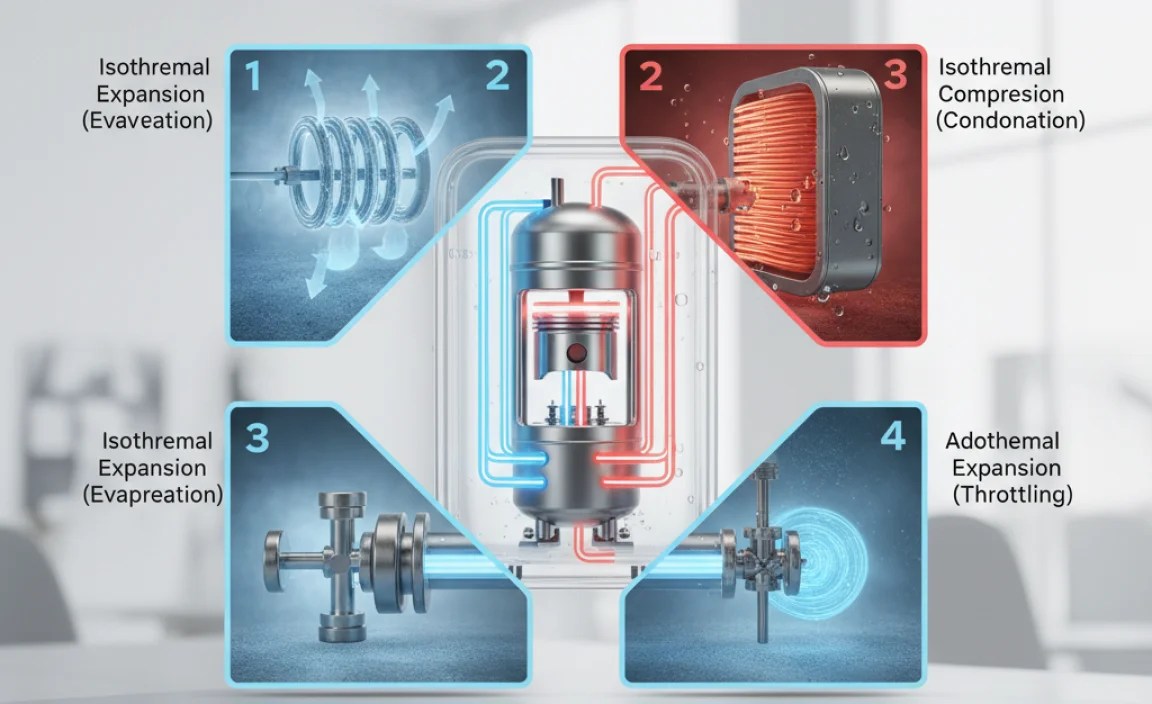
To fully grasp what makes a heat pump Carnot cycle, let’s walk through each of the four stages in detail:
1. Isothermal Expansion
In this stage, the working fluid (refrigerant) absorbs heat from the low-temperature reservoir (e.g., outside air) at a constant temperature. This happens in the evaporator. The refrigerant changes from a liquid to a gas as it absorbs heat. Imagine the refrigerant flowing through coils outside your house, pulling in heat even on a cold day. The key here is maintaining a constant temperature during the heat absorption process.
2. Adiabatic Compression
Next, the refrigerant vapor is compressed by a compressor. This compression increases both its temperature and pressure. The process is adiabatic, meaning no heat is exchanged with the surroundings. This rapid compression is crucial for raising the refrigerant’s temperature above that of the high-temperature reservoir (e.g., inside your home). Think of it like squeezing a bike pump quickly; the air inside gets hotter.
3. Isothermal Compression
Here, the high-temperature, high-pressure refrigerant releases heat to the high-temperature reservoir (e.g., inside your home) at a constant temperature. This occurs in the condenser. As the refrigerant releases heat, it changes from a gas back to a liquid. This is the stage where your home gets heated. The heat is transferred efficiently because the temperature remains constant during the phase change.
4. Adiabatic Expansion
Finally, the liquid refrigerant expands through an expansion valve, causing a significant drop in both its temperature and pressure. This process is adiabatic, meaning no heat is exchanged. The refrigerant is now colder than the low-temperature reservoir, ready to begin the cycle again. This expansion cools the refrigerant so it can effectively absorb heat from the outside in the next cycle.
Factors Affecting Efficiency
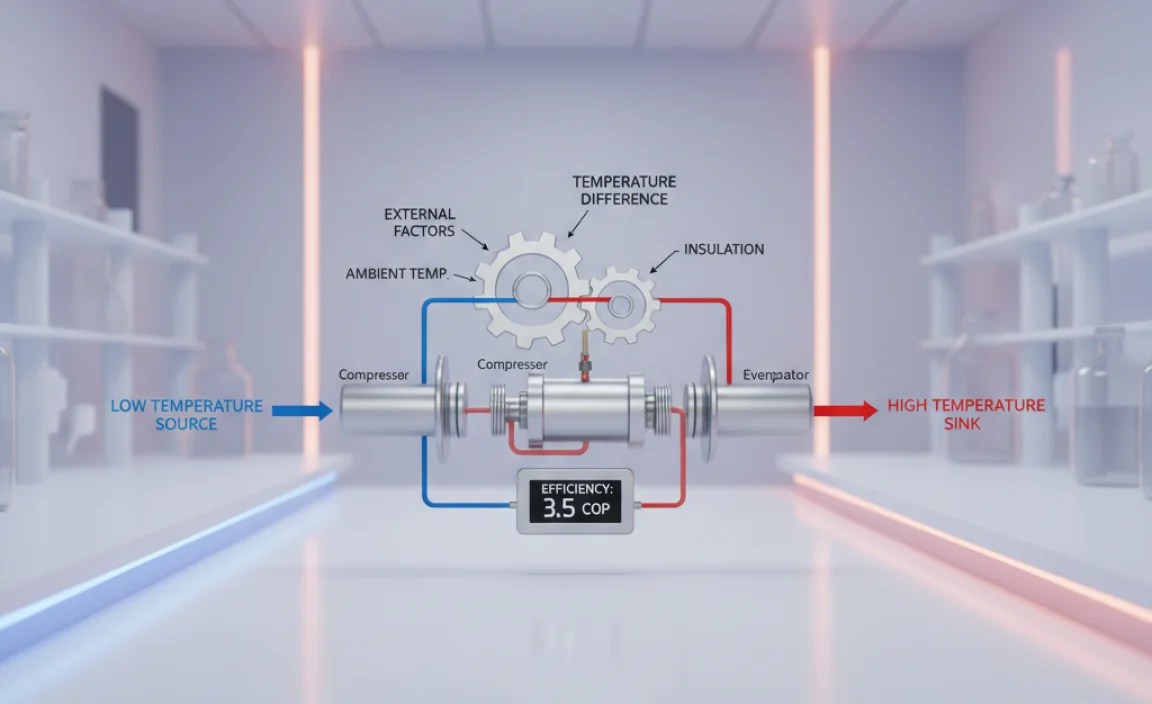
While the Carnot cycle provides a theoretical maximum efficiency, several factors can affect the actual performance of a heat pump. Understanding these factors is crucial for optimizing heat pump operation and maximizing energy savings. Here are some key considerations:
- Temperature Difference: The efficiency of a heat pump Carnot cycle is highly dependent on the temperature difference between the hot and cold reservoirs. A smaller temperature difference results in higher efficiency. This is because less work is required to transfer heat across a smaller temperature gradient. In practical terms, this means that heat pumps perform best when the temperature difference between the inside and outside is minimal.
- Working Fluid Properties: The choice of working fluid can significantly impact the performance of a heat pump. Different refrigerants have different thermodynamic properties, such as boiling point, heat capacity, and thermal conductivity. Selecting a refrigerant that is well-suited for the operating temperature range and heat transfer requirements is essential for maximizing efficiency.
- Component Efficiency: The efficiency of individual components, such as the compressor, expansion valve, and heat exchangers, can also affect the overall performance of the heat pump. Inefficiencies in these components can lead to energy losses and reduced efficiency. For example, a compressor with high friction losses will require more work to compress the refrigerant, reducing the overall coefficient of performance (COP).
- Reversibility: The Carnot cycle assumes that all processes are reversible, meaning that they occur infinitesimally slowly and without any losses due to friction, turbulence, or other irreversible effects. However, in reality, all processes are irreversible to some extent. Minimizing irreversibilities is crucial for approaching the Carnot efficiency limit. This can be achieved by optimizing component design, reducing pressure drops, and ensuring smooth flow of the working fluid.
- Heat Losses: Heat losses to the surroundings can also reduce the efficiency of a heat pump. Insulation can help minimize heat losses from the heat exchangers and other components. Proper sealing of the system can also prevent air leaks, which can contribute to heat losses.
Practical Implications and Limitations

While the Carnot cycle is a valuable theoretical model, it’s essential to recognize its limitations in real-world applications. Achieving true reversibility is impossible, and practical heat pumps always operate with some degree of irreversibility. This means that the actual efficiency of a heat pump will always be lower than the Carnot efficiency. However, the Carnot cycle still provides a useful benchmark for evaluating the performance of real-world heat pumps and identifying areas for improvement.
One of the main challenges in implementing a Carnot cycle is the requirement for isothermal processes. Maintaining a constant temperature during heat transfer requires very slow processes, which can limit the heat transfer rate and reduce the overall capacity of the heat pump. In practice, heat pumps often use modified cycles, such as the vapor-compression cycle, which are more practical but less efficient than the Carnot cycle.
Despite these limitations, the principles of the Carnot cycle are still relevant to the design and operation of heat pumps. By understanding the factors that affect efficiency, engineers can optimize heat pump performance and reduce energy consumption. For example, using advanced control strategies to minimize temperature differences and improve component efficiency can help approach the Carnot efficiency limit.
Comparing Carnot Cycle to Real-World Heat Pumps
The Carnot cycle, while theoretically perfect, differs significantly from real-world heat pumps. Let’s compare their characteristics in a table:
| Feature | Carnot Cycle | Real-World Heat Pumps |
|---|---|---|
| Efficiency | Maximum theoretical efficiency | Lower efficiency due to irreversibilities |
| Processes | Idealized, reversible processes | Irreversible processes |
| Isothermal Processes | Requires perfect isothermal conditions | Approximates isothermal conditions |
| Adiabatic Processes | Perfectly adiabatic (no heat exchange) | Some heat exchange occurs |
| Working Fluid | Ideal gas | Refrigerants (e.g., R-134a, R-410A) |
| Practicality | Theoretical, not practical | Practical and widely used |
Coefficient of Performance (COP)
The Coefficient of Performance (COP) is a crucial metric for evaluating the efficiency of a heat pump. It represents the ratio of heat delivered to the work required. For a heat pump operating in heating mode, the COP is defined as:
COP = Heat Delivered / Work Input
A higher COP indicates a more efficient heat pump. For example, a heat pump with a COP of 4 can deliver 4 units of heat for every 1 unit of electricity consumed. The COP of a heat pump depends on the temperature difference between the hot and cold reservoirs, as well as the efficiency of the components.
The Carnot COP, which represents the maximum theoretical COP for a heat pump operating between two given temperatures, is given by:
COP_Carnot = T_H / (T_H – T_C)
Where T_H is the absolute temperature of the hot reservoir and T_C is the absolute temperature of the cold reservoir. This equation highlights the importance of minimizing the temperature difference between the reservoirs to achieve higher efficiency.
In real-world heat pumps, the COP is always lower than the Carnot COP due to irreversibilities. However, manufacturers strive to improve the COP by optimizing component design, using advanced control strategies, and selecting appropriate refrigerants.
Advanced Technologies and Future Trends
The field of heat pump technology is constantly evolving, with ongoing research and development efforts focused on improving efficiency, reducing environmental impact, and expanding the range of applications. Some of the key advanced technologies and future trends include:
- Variable-Speed Compressors: These compressors can adjust their speed to match the heating or cooling demand, allowing for more efficient operation at partial loads. Variable-speed compressors can significantly improve the COP and reduce energy consumption, especially in applications with fluctuating loads.
- Advanced Refrigerants: Researchers are developing new refrigerants with lower global warming potential (GWP) and higher energy efficiency. These refrigerants aim to replace traditional refrigerants that contribute to climate change. Examples include hydrofluoroolefins (HFOs) and natural refrigerants like carbon dioxide and ammonia.
- Smart Controls: Smart control systems use sensors, data analytics, and machine learning algorithms to optimize heat pump operation in real-time. These systems can adjust the heating or cooling output based on occupancy patterns, weather conditions, and energy prices, maximizing energy savings and comfort.
- Geothermal Heat Pumps: These heat pumps use the Earth’s stable temperature as a heat source or sink, providing higher efficiency and more consistent performance compared to air-source heat pumps. Geothermal heat pumps can be more expensive to install, but they offer lower operating costs and reduced environmental impact.
- Thermally Driven Heat Pumps: These heat pumps use thermal energy, such as waste heat or solar energy, to drive the cycle, reducing the reliance on electricity. Thermally driven heat pumps can be particularly attractive for applications where waste heat is readily available, such as industrial processes or combined heat and power (CHP) systems.
Practical Tips for Maximizing Heat Pump Efficiency
Even with the best technology, proper operation and maintenance are crucial for maximizing heat pump efficiency. Here are some practical tips for homeowners and building managers:
- Regular Maintenance: Schedule regular maintenance checks to ensure that the heat pump is operating efficiently. This includes cleaning or replacing air filters, inspecting coils, and checking refrigerant levels.
- Proper Insulation: Ensure that the building is well-insulated to minimize heat losses. This includes insulating walls, ceilings, and floors, as well as sealing any air leaks.
- Smart Thermostat: Use a smart thermostat to program heating and cooling schedules based on occupancy patterns. This can help reduce energy consumption when the building is unoccupied.
- Avoid Extreme Temperature Settings: Avoid setting the thermostat to extreme temperatures, as this can reduce the efficiency of the heat pump. A smaller temperature difference between the inside and outside will result in higher efficiency.
- Keep Outdoor Unit Clear: Keep the outdoor unit free of obstructions, such as snow, ice, and vegetation. This will ensure proper airflow and prevent damage to the unit.
Troubleshooting Common Issues
Even with proper maintenance, heat pumps can experience occasional issues. Here are some common problems and how to troubleshoot them:
| Issue | Possible Cause | Solution |
|---|---|---|
| Heat pump not heating or cooling | Dirty air filter, refrigerant leak, compressor failure | Replace air filter, call a technician to check for leaks or compressor issues |
| Unusual noises | Loose components, fan blade obstruction, compressor problems | Inspect for loose parts or obstructions, call a technician for compressor issues |
| Ice buildup on outdoor unit | Defrost cycle malfunction, low refrigerant levels | Check defrost settings, call a technician to check refrigerant levels |
| High energy bills | Inefficient operation, temperature settings, poor insulation | Optimize settings, improve insulation, schedule maintenance |
External Resources
For more detailed information on heat pumps and the Carnot cycle, consider these resources:
- U.S. Department of Energy – Heat Pump Systems
- Environmental Protection Agency – Heat Pump Basics
FAQ Section
What is the Carnot cycle?
The Carnot cycle is a theoretical thermodynamic cycle that defines the maximum possible efficiency for converting heat into work, or vice versa, between two temperature reservoirs. It consists of four reversible processes: isothermal expansion, adiabatic expansion, isothermal compression, and adiabatic compression.
How does a heat pump Carnot cycle work?
A heat pump Carnot cycle uses a working fluid to transfer heat from a cold reservoir to a hot reservoir. The fluid undergoes isothermal and adiabatic processes to absorb heat at a low temperature and release it at a high temperature, requiring work input to complete the cycle.
What makes the Carnot cycle the most efficient?
The Carnot cycle is the most efficient because it’s entirely reversible, meaning there are no energy losses due to friction, turbulence, or other irreversible effects. All processes occur infinitesimally slowly, ensuring the system is always in equilibrium.
What is COP in a heat pump?
COP stands for Coefficient of Performance. It’s a ratio that measures how much heat a heat pump delivers for every unit of energy it consumes. A higher COP means the heat pump is more efficient.
Why are real-world heat pumps less efficient than the Carnot cycle?
Real-world heat pumps are less efficient because they operate with irreversible processes. Friction, heat losses, and non-ideal conditions reduce their efficiency compared to the theoretical, perfectly reversible Carnot cycle.
How can I improve the efficiency of my heat pump?
To improve your heat pump’s efficiency, ensure regular maintenance, use a smart thermostat, improve insulation, and keep the outdoor unit free of obstructions. Also, avoid setting extreme temperature settings.
What are some advanced technologies in heat pumps?
Advanced technologies include variable-speed compressors, advanced refrigerants with lower global warming potential, smart controls for real-time optimization, geothermal heat pumps utilizing stable Earth temperatures, and thermally driven heat pumps using waste or solar energy.
Conclusion
Understanding what makes a heat pump Carnot cycle involves grasping the principles of thermodynamics and the ideal conditions for heat transfer. While real-world heat pumps can’t achieve the perfect efficiency of the Carnot cycle, the underlying principles guide engineers in designing and optimizing these systems. By minimizing temperature differences, using advanced components, and ensuring proper maintenance, you can maximize the efficiency of your heat pump and reduce energy consumption. Keep these tips in mind, and you’ll be well-equipped to make informed decisions about your heating and cooling needs.
“`


