
Understanding Heat Pumps: Mastering the Ideal Vapor-Compression Cycle

Quick Summary: A heat pump using the ideal vapor-compression cycle transfers heat efficiently by cycling a refrigerant through four key components: evaporator, compressor, condenser, and expansion valve. This process involves evaporation, compression, condensation, and expansion, moving heat from a cold space to a warm one. Understanding each stage is crucial for efficient operation and troubleshooting.
Ever wondered how your heat pump keeps you cozy in the winter and cool in the summer? It all comes down to something called the vapor-compression cycle. It might sound complicated, but it’s a straightforward process of moving heat from one place to another using a special refrigerant. Many homeowners find the technology behind their heating and cooling systems to be mysterious, but don’t worry! We’ll break down each step of this cycle, so you’ll understand exactly how your heat pump works. By the end of this article, you’ll have a solid grasp of how a heat pump operates on the ideal vapor-compression cycle and be able to troubleshoot common issues.
The Four Key Components of a Heat Pump

Before diving into the cycle itself, let’s meet the main players. A heat pump has four essential components:
- Evaporator: This is where the refrigerant absorbs heat and turns into a vapor.
- Compressor: The compressor increases the pressure and temperature of the refrigerant vapor.
- Condenser: Here, the refrigerant releases heat and turns back into a liquid.
- Expansion Valve (or Throttling Valve): This valve reduces the pressure and temperature of the refrigerant before it enters the evaporator.
The Ideal Vapor-Compression Cycle: A Step-by-Step Guide

The vapor-compression cycle consists of four main processes. Let’s walk through each one:
1. Evaporation
The cycle begins in the evaporator. Here’s what happens:
- Low-Pressure Refrigerant: The refrigerant enters the evaporator as a low-pressure, low-temperature liquid.
- Heat Absorption: The refrigerant absorbs heat from the surrounding environment (e.g., outdoor air in heating mode or indoor air in cooling mode).
- Phase Change: As it absorbs heat, the refrigerant evaporates, turning into a low-pressure, low-temperature vapor.
Think of it like water boiling on a stove, but at a much lower temperature.
2. Compression
Next up is the compressor, which plays a vital role:
- Vapor Enters: The low-pressure, low-temperature vapor enters the compressor.
- Pressure Increase: The compressor increases the pressure of the refrigerant vapor.
- Temperature Increase: As the pressure increases, so does the temperature. The refrigerant leaves the compressor as a high-pressure, high-temperature vapor.
This step is crucial because it raises the temperature of the refrigerant above that of the environment where heat needs to be released (e.g., inside your home in heating mode).
3. Condensation
The high-pressure, high-temperature vapor then moves to the condenser:
- Heat Release: The refrigerant releases heat to the surrounding environment (e.g., indoor air in heating mode or outdoor air in cooling mode).
- Phase Change: As it releases heat, the refrigerant condenses, turning back into a high-pressure, high-temperature liquid.
This is similar to steam turning back into water as it cools down.
4. Expansion
Finally, the refrigerant goes through the expansion valve:
- Pressure Reduction: The high-pressure, high-temperature liquid passes through the expansion valve, which reduces its pressure.
- Temperature Reduction: As the pressure drops, so does the temperature. The refrigerant exits the expansion valve as a low-pressure, low-temperature liquid, ready to start the cycle again.
This step prepares the refrigerant to absorb heat in the evaporator, restarting the entire process.
The Vapor-Compression Cycle in Action: Heating and Cooling Modes

The magic of a heat pump lies in its ability to reverse the cycle, providing both heating and cooling. Here’s how it works in each mode:
Heating Mode
- Heat Source: The evaporator absorbs heat from the outdoor air (even in cold temperatures).
- Heat Delivery: The condenser releases heat into your home.
- Refrigerant Flow: A reversing valve changes the direction of refrigerant flow, allowing the outdoor coil to act as the evaporator and the indoor coil as the condenser.
Cooling Mode
- Heat Source: The evaporator absorbs heat from the indoor air.
- Heat Delivery: The condenser releases heat to the outdoor air.
- Refrigerant Flow: The reversing valve switches back, making the indoor coil the evaporator and the outdoor coil the condenser.
Ideal vs. Real-World Vapor-Compression Cycles

It’s important to understand the difference between the “ideal” vapor-compression cycle and what happens in real-world heat pumps.
Ideal Cycle
- Assumptions: The ideal cycle assumes processes are reversible and occur without any losses (e.g., no pressure drops, no superheating, no subcooling).
- Efficiency: It provides a theoretical maximum efficiency that a heat pump could achieve.
- Simplicity: It simplifies the analysis and understanding of the basic principles.
Real-World Cycle
- Inefficiencies: Real-world cycles include irreversible processes like friction, pressure drops, and heat transfer losses.
- Superheating and Subcooling: These are often used to improve efficiency and protect the compressor. Superheating ensures that only vapor enters the compressor, while subcooling ensures that only liquid enters the expansion valve.
- Performance: The actual performance of a heat pump will always be lower than the ideal cycle due to these inefficiencies.
Here’s a table summarizing the key differences:
| Feature | Ideal Vapor-Compression Cycle | Real-World Vapor-Compression Cycle |
|---|---|---|
| Processes | Reversible | Irreversible |
| Losses | No losses | Includes friction, pressure drops, heat transfer losses |
| Superheating/Subcooling | Not considered | Often used to improve efficiency |
| Efficiency | Theoretical maximum | Lower due to inefficiencies |
Factors Affecting Heat Pump Performance
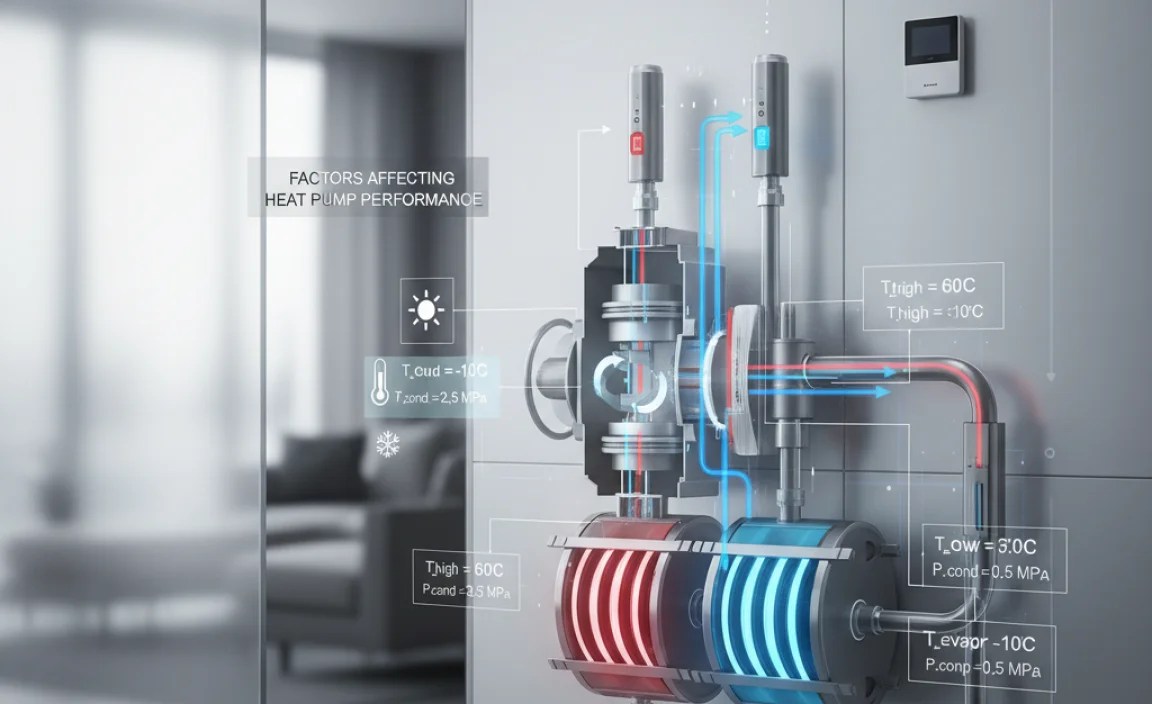
Several factors can impact the performance of a heat pump operating on the vapor-compression cycle:
- Refrigerant Type: Different refrigerants have different thermodynamic properties, affecting efficiency and environmental impact. Common refrigerants include R-410A and R-32.
- Ambient Temperature: Heat pump efficiency decreases as the temperature difference between the heat source and the heat sink increases. In heating mode, very cold outdoor temperatures can reduce performance.
- Compressor Efficiency: The efficiency of the compressor is crucial. A more efficient compressor will use less energy to compress the refrigerant.
- Heat Exchanger Design: The design and surface area of the evaporator and condenser affect their ability to transfer heat.
- Maintenance: Regular maintenance, such as cleaning coils and changing filters, is essential for maintaining optimal performance. Dirty coils and filters can reduce airflow and heat transfer.
- Refrigerant Charge: The correct refrigerant charge is critical. Overcharging or undercharging can significantly reduce efficiency and potentially damage the compressor.
Troubleshooting Common Heat Pump Issues
Understanding the vapor-compression cycle can help you troubleshoot common heat pump problems:
- Problem: Heat pump not heating or cooling effectively.
- Possible Cause: Refrigerant leak.
- Explanation: A leak reduces the amount of refrigerant in the system, affecting its ability to transfer heat.
- Solution: Call a professional to locate and repair the leak and recharge the refrigerant.
- Problem: Ice buildup on the outdoor unit.
- Possible Cause: Defrost cycle malfunction.
- Explanation: Heat pumps have a defrost cycle to melt ice that forms on the outdoor coil. If this cycle isn’t working, ice can accumulate, reducing efficiency.
- Solution: Check the defrost settings and ensure the defrost cycle is functioning correctly. If not, consult a technician.
- Problem: Unusual noises from the unit.
- Possible Cause: Compressor issues.
- Explanation: Strange noises could indicate a problem with the compressor, such as worn bearings or a failing motor.
- Solution: Turn off the unit and call a professional for inspection and repair.
- Problem: High energy bills.
- Possible Cause: Inefficient operation.
- Explanation: Several factors can cause inefficiency, including dirty coils, a malfunctioning compressor, or a refrigerant leak.
- Solution: Schedule a maintenance check to identify and address any issues.
The Future of Vapor-Compression Technology
The vapor-compression cycle is a mature technology, but ongoing research and development are focused on improving its efficiency and reducing its environmental impact. Some key areas of innovation include:
- New Refrigerants: Developing refrigerants with lower global warming potential (GWP) to replace older, more harmful substances.
- Advanced Compressors: Designing more efficient compressors, such as variable-speed compressors, that can adjust their output to match the heating or cooling demand.
- Improved Heat Exchangers: Creating heat exchangers with enhanced heat transfer capabilities to maximize efficiency.
- Smart Controls: Implementing smart controls and sensors to optimize heat pump operation based on real-time conditions and user preferences.
Resources for Further Learning
Want to dive deeper into heat pump technology? Here are some resources:
- U.S. Department of Energy (DOE): The DOE provides extensive information on heat pumps and energy efficiency (energy.gov).
- Air Conditioning, Heating, and Refrigeration Institute (AHRI): AHRI offers standards and certifications for HVAC equipment (ahrinet.org).
- ASHRAE (American Society of Heating, Refrigerating and Air-Conditioning Engineers): ASHRAE provides technical resources and standards for the HVAC industry (ashrae.org).
FAQ: Understanding Heat Pumps and the Vapor-Compression Cycle
Here are some frequently asked questions to help clarify the concepts discussed:
- What exactly is a heat pump?
- A heat pump is a device that transfers heat from one place to another. It can be used for both heating and cooling by reversing the direction of refrigerant flow.
- How does the vapor-compression cycle work?
- The vapor-compression cycle involves four main processes: evaporation, compression, condensation, and expansion. It uses a refrigerant to absorb heat in one location and release it in another.
- What are the main components of a heat pump?
- The main components are the evaporator, compressor, condenser, and expansion valve. Each plays a crucial role in the vapor-compression cycle.
- Is a heat pump efficient?
- Yes, heat pumps are generally very efficient because they move heat rather than generate it. However, their efficiency can be affected by factors like ambient temperature and maintenance.
- What is the difference between the ideal and real-world vapor-compression cycle?
- The ideal cycle assumes no losses and reversible processes, providing a theoretical maximum efficiency. The real-world cycle includes inefficiencies like friction and pressure drops, resulting in lower actual performance.
- How often should I service my heat pump?
- It’s generally recommended to have your heat pump serviced annually to ensure optimal performance and efficiency.
- Can I install a heat pump myself?
- While some basic maintenance tasks can be done yourself, it’s best to have a professional install and service your heat pump to ensure it’s done correctly and safely.
Conclusion
Understanding how a heat pump operates on the ideal vapor-compression cycle empowers you to make informed decisions about your home’s heating and cooling system. By knowing the key components, the steps of the cycle, and the factors that affect performance, you can troubleshoot common issues and ensure your heat pump runs efficiently for years to come. Whether you’re a homeowner looking to save on energy bills or simply curious about the technology behind your HVAC system, this knowledge is invaluable. Keep this guide handy, and you’ll be well-equipped to keep your home comfortable year-round!
“`


