
Are Pumps Isentropic in the Ideal Rankine Cycle? A Simple Guide

Quick Summary: In the ideal Rankine cycle, pumps are considered isentropic, meaning they operate with no increase in entropy. This simplification assumes the pumping process is perfectly reversible and adiabatic (no heat transfer), making it an ideal scenario. In reality, pumps aren’t truly isentropic due to friction and inefficiencies, but the ideal model provides a useful theoretical benchmark.
Hey there, fellow cycling enthusiasts! Raymond Ammons here, from BicyclePumper.com. Have you ever wondered about the inner workings of engines and cycles, like the Rankine cycle? It might seem far removed from bike pumps, but understanding fundamental principles is always useful. One common question is whether pumps in the ideal Rankine cycle are isentropic. This can be a bit confusing, but don’t worry! I’m here to break it down for you in simple terms. We’ll explore what “isentropic” means, why it’s assumed in the ideal Rankine cycle, and what the real-world implications are. Let’s get started!
What is the Rankine Cycle?

The Rankine cycle is a thermodynamic cycle that converts heat into mechanical work. It’s the fundamental principle behind steam power plants, which generate electricity by using steam to turn turbines. Think of it as the engine that powers much of our world!
The Rankine cycle consists of four main components:
- Pump: Increases the pressure of the working fluid (usually water)
- Boiler: Heats the high-pressure water to create steam
- Turbine: Expands the high-pressure steam to generate power
- Condenser: Cools the steam to condense it back into water
Understanding Isentropic Processes
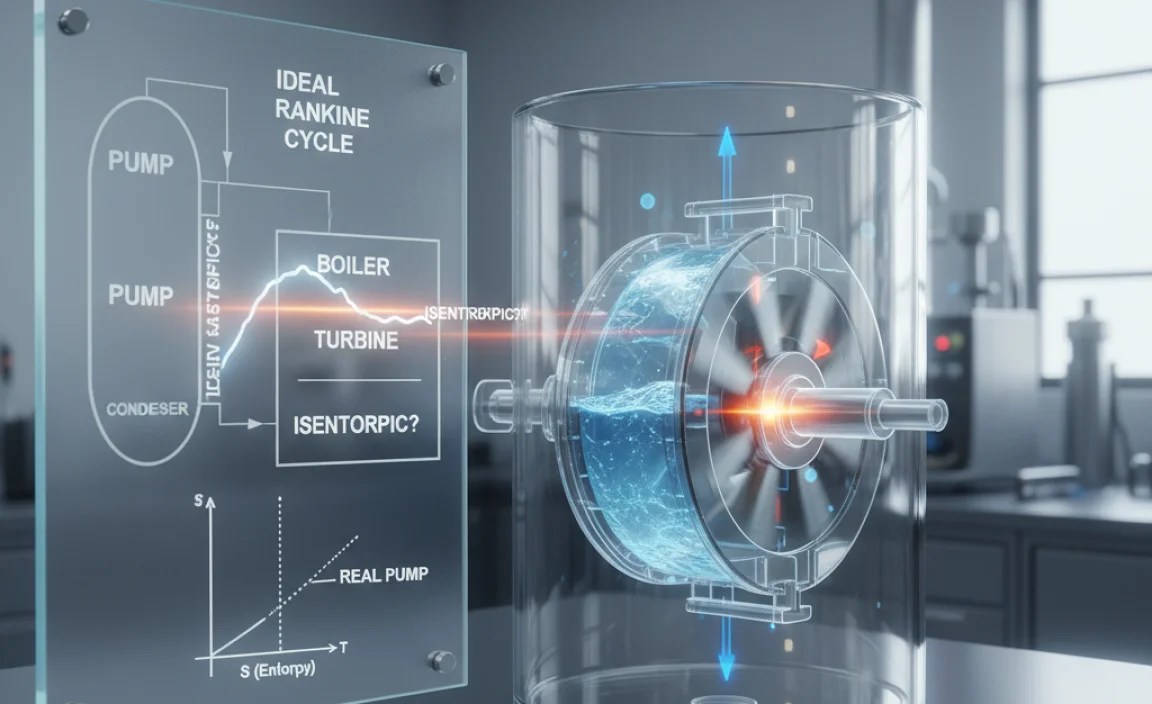
Before we dive into pumps, let’s clarify what “isentropic” means. An isentropic process is one that is both adiabatic (no heat transfer into or out of the system) and reversible (no energy losses due to friction or other factors). In simpler terms, it’s a process that happens without any change in entropy. Entropy, in this context, is a measure of the disorder or randomness of a system.
Think of it like this: imagine perfectly pumping up your bike tire with zero friction and no heat escaping. That would be an isentropic process. Of course, in reality, some heat is generated, and there’s always a bit of friction, but the ideal scenario helps us simplify the calculations.
The Ideal Rankine Cycle and Isentropic Pumps

In the ideal Rankine cycle, the pump is assumed to be isentropic. This is a key simplification that makes the cycle easier to analyze and understand. Here’s why it’s assumed:
- Idealization: The ideal Rankine cycle is a theoretical model. It assumes perfect conditions to provide a benchmark for real-world performance.
- No Losses: An isentropic pump implies no energy losses due to friction, turbulence, or other irreversibilities within the pump.
- Simplified Calculations: Assuming isentropic behavior simplifies the thermodynamic calculations, allowing engineers to quickly estimate the cycle’s efficiency.
Therefore, in the ideal Rankine cycle, the pump increases the pressure of the water without increasing its entropy. The water enters the pump at a low pressure and exits at a high pressure, but its “disorder” remains the same.
Why Isentropic Pumps are an Idealization

While assuming isentropic pumps simplifies the ideal Rankine cycle, it’s important to remember that real-world pumps are never perfectly isentropic. Here’s why:
- Friction: Real pumps have moving parts that generate friction, which converts some of the input energy into heat. This heat increases the entropy of the fluid.
- Turbulence: The flow of water through the pump is often turbulent, creating eddies and mixing that also increase entropy.
- Heat Transfer: Although pumps are designed to minimize heat transfer, some heat exchange with the surroundings is inevitable.
Because of these factors, real pumps always have some degree of inefficiency. The isentropic efficiency of a pump is a measure of how close it comes to operating isentropically. It’s defined as the ratio of the actual work input to the pump to the work input required for an isentropic pump operating between the same inlet and outlet pressures.
The Impact of Pump Inefficiency on the Rankine Cycle

Pump inefficiency directly affects the overall efficiency of the Rankine cycle. Here’s how:
- Increased Work Input: An inefficient pump requires more work input to achieve the same pressure increase compared to an isentropic pump.
- Reduced Net Work Output: The increased work input reduces the net work output of the cycle (turbine work minus pump work).
- Lower Thermal Efficiency: Since thermal efficiency is defined as net work output divided by heat input, a lower net work output results in a lower thermal efficiency.
Therefore, minimizing pump inefficiency is crucial for maximizing the performance of the Rankine cycle. Engineers use various design strategies to improve pump efficiency, such as:
- Optimizing Impeller Design: Designing pump impellers to minimize turbulence and friction.
- Using High-Quality Materials: Employing materials that reduce friction and wear.
- Improving Sealing: Minimizing leakage to reduce energy losses.
Calculating Isentropic Pump Work
Let’s look at how we can calculate the work required by an isentropic pump. The work done by an isentropic pump can be calculated using the following formula:
Wisentropic = v * (P2 – P1)
Where:
- Wisentropic is the work done by the isentropic pump (J/kg)
- v is the specific volume of the fluid (m3/kg)
- P1 is the inlet pressure (Pa)
- P2 is the outlet pressure (Pa)
For a real (non-isentropic) pump, the work done will be higher than the isentropic work due to inefficiencies. We can express the actual work as:
Wactual = Wisentropic / ηpump
Where:
- ηpump is the isentropic efficiency of the pump (between 0 and 1)
Comparing Ideal vs. Real Pumps
To better understand the difference between ideal and real pumps, let’s look at a table that summarizes the key characteristics:
| Characteristic | Ideal (Isentropic) Pump | Real Pump |
|---|---|---|
| Entropy Change | Zero (Δs = 0) | Positive (Δs > 0) |
| Efficiency | 100% | Less than 100% |
| Work Input | Minimum | Higher than minimum |
| Reversibility | Reversible | Irreversible |
| Heat Transfer | No heat transfer (adiabatic) | Minimal, but some heat transfer may occur |
Practical Implications for Cyclists
While the Rankine cycle and isentropic pumps might seem far removed from cycling, understanding these concepts can help you appreciate the importance of efficiency in various systems. For example, consider your bike pump:
- Pump Efficiency: A more efficient bike pump requires less effort to inflate your tires to the desired pressure.
- Friction: Internal friction in the pump can make it harder to use and generate heat, which is wasted energy.
- Maintenance: Regular maintenance, such as lubricating the pump’s moving parts, can help reduce friction and improve its efficiency.
By understanding the principles behind efficiency and energy losses, you can make informed choices about the equipment you use and how you maintain it. Just like engineers strive to improve the efficiency of Rankine cycle pumps, cyclists can strive to optimize their equipment and techniques for better performance.
Step-by-Step: Estimating Pump Efficiency
While precisely measuring pump efficiency requires specialized equipment, here’s a simple way to estimate it:
- Measure Input: Use a pressure gauge to measure the initial tire pressure (P1).
- Pump and Measure: Pump a specific number of strokes (e.g., 10 strokes) and measure the final tire pressure (P2). Keep track of the effort or time spent.
- Compare: Compare the pressure increase with different pumps or after maintenance. A more efficient pump will achieve a greater pressure increase with the same number of strokes and effort.
- Qualitative Assessment: Feel the pump for heat generation. A less efficient pump will likely get hotter due to friction.
This method provides a qualitative assessment of pump efficiency, allowing you to compare different pumps or evaluate the impact of maintenance on your existing pump.
Troubleshooting Common Pump Issues
Here’s a quick guide to addressing common bike pump problems:
- Problem: Pump is hard to push.
- Possible Cause: Lack of lubrication.
- Solution: Apply a small amount of lubricant (e.g., silicone grease) to the pump’s internal parts.
- Problem: Air leaks around the valve.
- Possible Cause: Worn valve seal.
- Solution: Replace the valve seal.
- Problem: Pump doesn’t build pressure.
- Possible Cause: Damaged piston or cylinder.
- Solution: Replace the pump.
External Resources
For deeper insights into thermodynamics and the Rankine cycle, consider exploring these resources:
- U.S. Department of Energy
- The Engineering ToolBox – Rankine Cycle
- Khan Academy – Thermodynamics
FAQ
Q: What does “isentropic” mean?
A: Isentropic means a process occurs with no change in entropy, implying it’s both adiabatic (no heat transfer) and reversible (no energy losses).
Q: Why is the pump assumed to be isentropic in the ideal Rankine cycle?
A: It’s an idealization to simplify calculations and provide a theoretical benchmark for cycle performance.
Q: Are real pumps isentropic?
A: No, real pumps are never perfectly isentropic due to friction, turbulence, and heat transfer.
Q: What is isentropic efficiency?
A: Isentropic efficiency is a measure of how closely a real pump approaches isentropic operation. It’s the ratio of ideal work to actual work.
Q: How does pump inefficiency affect the Rankine cycle?
A: Pump inefficiency reduces the net work output and overall thermal efficiency of the Rankine cycle.
Q: How can I improve my bike pump’s efficiency?
A: Regular lubrication and maintenance can help reduce friction and improve your pump’s efficiency.
Q: Where can I learn more about thermodynamics?
A: Resources like Khan Academy and engineering textbooks offer in-depth explanations of thermodynamics principles.
Conclusion
So, to answer the original question: yes, pumps are considered isentropic in the ideal Rankine cycle. However, it’s crucial to remember that this is a simplification. Real-world pumps always have some degree of inefficiency due to friction and other factors. Understanding the difference between ideal and real pumps helps us appreciate the importance of efficiency and the challenges engineers face in designing and optimizing thermodynamic systems. And while this may all seem very technical, remember that the underlying principles apply to everyday devices like your bike pump. Keep pumping, keep learning, and keep exploring the fascinating world of engineering! This is Raymond Ammons from BicyclePumper.com, signing off. Happy cycling!
“`


