
What Does a Pump in a Carnot Cycle Do? A Simple Guide

Quick Summary: In a Carnot cycle, the pump (or compressor) plays a crucial role by increasing the pressure and temperature of the working fluid (usually a gas) during the adiabatic compression stage. This process requires work input and prepares the fluid for the next phase of the cycle, increasing its ability to do work later on.
Ever wondered how engines and refrigerators work their magic? They often rely on cycles, and one of the most fundamental is the Carnot cycle. But what exactly does a pump do in this cycle, and why is it so important? It can seem complicated, but don’t worry! This guide breaks down the pump’s role in simple terms, making it easy to understand. We’ll go step-by-step, so you’ll know exactly what’s happening. Ready to dive in and discover the secrets of the Carnot cycle pump?
Understanding the Carnot Cycle
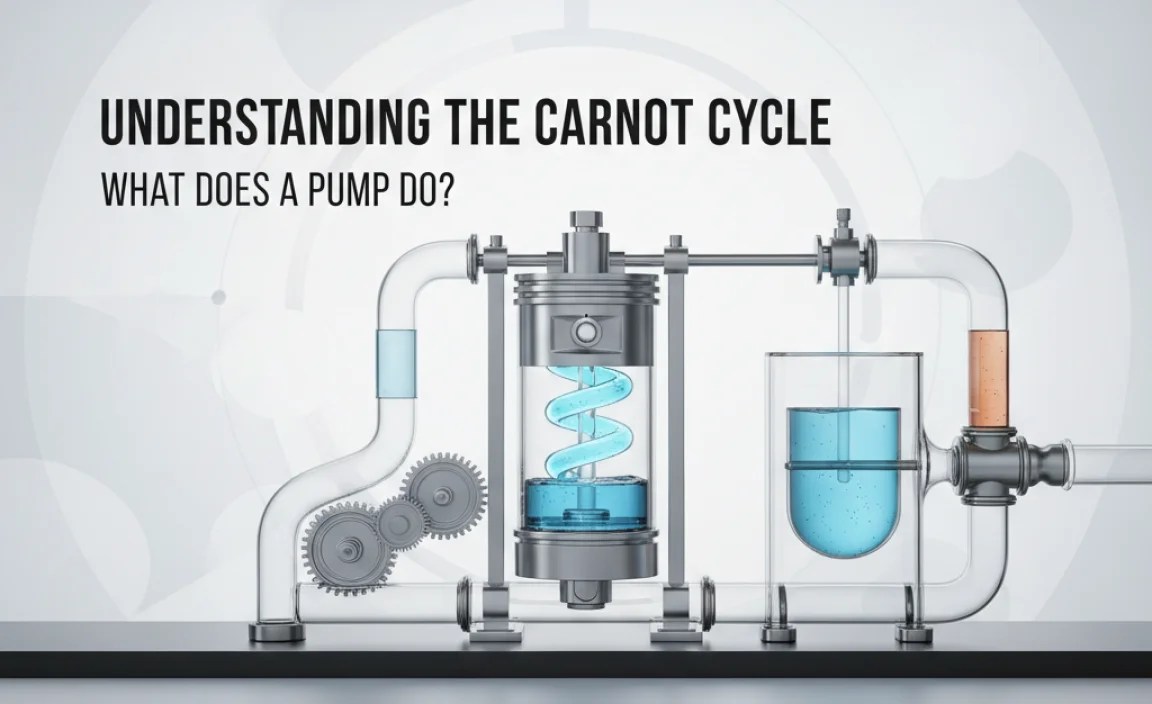
The Carnot cycle is a theoretical thermodynamic cycle that provides the maximum possible efficiency for converting heat into work, or conversely, using work to transfer heat (like in a refrigerator). It consists of four reversible processes:
- Isothermal Expansion: The system absorbs heat at a constant high temperature.
- Adiabatic Expansion: The system expands and cools without exchanging heat with the surroundings.
- Isothermal Compression: The system releases heat at a constant low temperature.
- Adiabatic Compression: The system is compressed, increasing its temperature without exchanging heat with the surroundings. This is where the pump comes in!
Think of it like pedaling your bike uphill and downhill. The Carnot cycle is like a perfectly efficient route, using every bit of your energy wisely.
The Pump’s Role: Adiabatic Compression Explained

The pump is responsible for the adiabatic compression phase of the Carnot cycle. This process involves increasing the pressure and temperature of the working fluid (typically a gas) without allowing any heat to enter or leave the system. Here’s a closer look:
What Happens During Adiabatic Compression?
- Volume Reduction: The pump decreases the volume occupied by the working fluid.
- Pressure Increase: As the volume decreases, the pressure of the fluid increases significantly.
- Temperature Increase: Compressing the gas also raises its temperature. This is because the work done by the pump on the gas is converted into internal energy, increasing the kinetic energy of the gas molecules.
Imagine squeezing air with a bike pump – you’re reducing the volume, increasing the pressure, and the pump gets warm. That’s adiabatic compression in action!
Why is Adiabatic Compression Important?
Adiabatic compression is vital because it:
- Increases the Fluid’s Energy: By raising the temperature and pressure, the fluid gains more potential to do work in the subsequent expansion phases.
- Prepares for Isothermal Heat Rejection: The compressed, high-temperature fluid is now ready to release heat at the lower temperature reservoir during the isothermal compression phase.
- Completes the Cycle: Adiabatic compression brings the working fluid back to its initial state, ready for the cycle to repeat.
Types of Pumps Used in Thermodynamic Cycles

While the Carnot cycle is theoretical, real-world applications use various types of pumps or compressors to achieve adiabatic compression. Here are a few common examples:
- Piston Compressors: These use a piston moving within a cylinder to compress the gas. They are commonly found in air compressors and some refrigeration systems.
- Rotary Compressors: These use rotating elements, such as screws or vanes, to compress the gas. They are often used in air conditioning and industrial applications.
- Centrifugal Compressors: These use a rotating impeller to increase the velocity of the gas, which is then converted into pressure. They are commonly used in large-scale industrial processes.
Just like there are different types of bike pumps (floor pumps, mini pumps, CO2 inflators), there are different compressors suited for specific jobs.
The Ideal vs. Real-World Pumps

In the theoretical Carnot cycle, the pump is assumed to be perfectly efficient and reversible. However, real-world pumps always have some losses due to friction, turbulence, and other factors. This means that the actual work required to compress the gas is higher than the ideal work predicted by the Carnot cycle.
To account for these losses, engineers use concepts like isentropic efficiency, which compares the actual performance of the pump to its ideal performance under reversible adiabatic conditions.
Think of it like this: The Carnot cycle is the perfect, smooth road. Real roads have bumps and potholes (losses), making the ride a bit harder.
Carnot Cycle Efficiency: The Ideal Limit

The Carnot cycle is famous for setting the upper limit on the efficiency of any heat engine operating between two temperature reservoirs. The efficiency of the Carnot cycle is given by:
Efficiency = 1 – (Tc / Th)
Where:
- Tc is the absolute temperature of the cold reservoir (in Kelvin or Rankine).
- Th is the absolute temperature of the hot reservoir (in Kelvin or Rankine).
This formula tells us that the greater the temperature difference between the hot and cold reservoirs, the higher the potential efficiency of the cycle. However, no real-world engine can achieve the Carnot efficiency due to the irreversibilities present in practical systems.
The Carnot efficiency is a theoretical ceiling; real-world engines always fall short due to friction and other inefficiencies.
Applications of the Carnot Cycle
Although the Carnot cycle is an idealization, it has significant practical implications. It provides a benchmark for evaluating the performance of real engines and refrigerators, and it helps engineers identify areas where improvements can be made. Here are some applications:
- Power Generation: Understanding the Carnot cycle helps in designing more efficient power plants.
- Refrigeration: The principles of the Carnot cycle are used in designing refrigerators and air conditioners.
- Engine Design: Engineers use the Carnot cycle as a reference point for optimizing engine performance.
The Carnot cycle is like the blueprint for efficient energy use, guiding the design of everything from power plants to refrigerators.
Practical Examples of Pumps in Action
To really understand the pump’s role, let’s look at a few practical examples:
Example 1: Refrigerator
In a refrigerator, a compressor (the pump) compresses a refrigerant gas, increasing its temperature and pressure. This hot, high-pressure gas then flows through a condenser, where it releases heat to the surroundings and becomes a liquid. The liquid refrigerant then passes through an expansion valve, where its pressure and temperature drop. Finally, the cold refrigerant absorbs heat from inside the refrigerator, cooling the interior. The cycle repeats as the refrigerant returns to the compressor.
Example 2: Air Conditioner
An air conditioner works on the same principle as a refrigerator. The compressor pumps refrigerant, which absorbs heat from inside your home and releases it outside. The pump is crucial for maintaining the temperature difference and keeping you cool.
Example 3: Internal Combustion Engine
While not a direct Carnot cycle application, the compression stroke in an internal combustion engine is similar to adiabatic compression. The piston compresses the air-fuel mixture, increasing its temperature and pressure before ignition. This compression is essential for efficient combustion.
Troubleshooting Common Pump Issues
Just like bike pumps, compressors and pumps in larger systems can run into issues. Here’s a quick troubleshooting guide:
- Reduced Efficiency: Check for leaks, worn parts, or inadequate lubrication.
- Overheating: Ensure proper ventilation and cooling.
- Noise and Vibration: Inspect for loose components or imbalance.
- Pressure Loss: Examine valves and seals for wear or damage.
Regular maintenance and timely repairs can keep your pumps running smoothly and efficiently.
How to Choose the Right Pump for the Job
Selecting the right pump or compressor depends on the specific application and requirements. Here are some factors to consider:
- Pressure Ratio: The ratio of discharge pressure to suction pressure.
- Flow Rate: The volume of fluid that the pump can move per unit time.
- Efficiency: The amount of work required to operate the pump.
- Type of Fluid: The properties of the fluid being pumped (e.g., viscosity, corrosiveness).
- Operating Conditions: The temperature, pressure, and environment in which the pump will operate.
Consulting with a pump specialist or engineer can help you choose the best pump for your needs.
The Future of Carnot Cycle Technology
Researchers are continually exploring ways to improve the efficiency and performance of thermodynamic cycles. Some areas of focus include:
- Advanced Materials: Developing new materials that can withstand higher temperatures and pressures.
- Improved Designs: Optimizing the design of pumps and other components to reduce losses.
- Alternative Working Fluids: Investigating new working fluids with better thermodynamic properties.
These advancements could lead to more efficient power generation, refrigeration, and other applications.
The Environmental Impact of Pumps
It’s essential to consider the environmental impact of pumps and compressors. Inefficient pumps consume more energy, leading to higher greenhouse gas emissions. Using energy-efficient pumps and implementing proper maintenance practices can help reduce their environmental footprint.
Here’s a table outlining the pros and cons of using pumps in the Carnot Cycle.
| Aspect | Pros | Cons |
|---|---|---|
| Efficiency | Increases overall cycle efficiency by raising fluid’s energy | Real-world pumps have inefficiencies (friction, turbulence) |
| Energy Input | Prepares fluid for isothermal heat rejection | Requires energy input to compress the fluid |
| Cycle Completion | Returns fluid to initial state for cycle repetition | Can contribute to energy waste if not optimized |
| Environmental Impact | Essential for refrigeration and power generation | Inefficient pumps increase energy consumption and emissions |
Maintaining Your Pumps for Optimal Performance
Regular maintenance is key to ensuring that your pumps operate efficiently and reliably. Here are some maintenance tips:
- Lubrication: Keep moving parts properly lubricated to reduce friction.
- Inspection: Regularly inspect pumps for leaks, wear, and damage.
- Cleaning: Clean pumps and surrounding areas to prevent debris buildup.
- Replacement: Replace worn or damaged parts promptly.
Following these maintenance tips can extend the life of your pumps and improve their performance.
Advanced Concepts in Carnot Cycle Pumps
For those interested in delving deeper, here are some advanced concepts related to Carnot cycle pumps:
- Multi-Stage Compression: Using multiple compression stages with intercooling to improve efficiency.
- Variable Speed Drives: Adjusting the pump speed to match the load requirements.
- Heat Recovery: Capturing waste heat from the compression process for other uses.
Resources for Further Learning
Want to learn more about the Carnot cycle and pumps? Here are some helpful resources:
- Engineering Textbooks: Textbooks on thermodynamics and heat transfer provide detailed explanations of the Carnot cycle.
- Online Courses: Platforms like Coursera and edX offer courses on thermodynamics and related topics.
- Technical Journals: Journals like the “Journal of Heat Transfer” publish research articles on advanced topics in thermodynamics.
- Government Resources: The U.S. Department of Energy provides resources on energy efficiency and renewable energy technologies: Energy.gov.
FAQ: Understanding the Pump in a Carnot Cycle
1. What exactly is a Carnot cycle?
The Carnot cycle is a theoretical model that shows the most efficient way to convert heat into work or use work to move heat, like in a fridge. It involves four steps: absorbing heat, expanding, releasing heat, and compressing.
2. Why is a pump important in the Carnot cycle?
The pump (or compressor) is essential because it increases the pressure and temperature of the working fluid. This makes the fluid ready to do work in the next steps of the cycle.
3. What does “adiabatic compression” mean?
Adiabatic compression is when the pump compresses the working fluid (like a gas) without letting any heat escape or enter. This makes the fluid hotter and increases its energy.
4. Can real-world engines achieve Carnot cycle efficiency?
No, real-world engines can’t be as efficient as the Carnot cycle because there are always some losses due to friction and other factors.
5. What are some examples of pumps used in real life?
Examples include the compressor in your refrigerator or air conditioner, and the compression stroke in a car engine.
6. How can I make sure my pumps are working well?
Regular maintenance is key. Keep them lubricated, check for leaks, and replace worn parts. This will help them run efficiently and last longer.
7. What happens if a pump is inefficient?
An inefficient pump uses more energy, which can lead to higher energy bills and a bigger impact on the environment due to increased emissions.
Conclusion
Understanding the role of the pump in a Carnot cycle is crucial for grasping the fundamentals of thermodynamics and energy conversion. While the Carnot cycle itself is a theoretical ideal, its principles are widely applied in the design and optimization of real-world engines, refrigerators, and other thermodynamic systems. By understanding the pump’s role in adiabatic compression, you can appreciate the intricate workings of these technologies and their impact on our daily lives. So, next time you’re pumping up your bike tires, remember the principles of the Carnot cycle and the vital role of compression!
“`


