
What Is Pumped in the Calvin Cycle? A Simple Guide

The Calvin Cycle doesn’t “pump” anything in the way a bike pump moves air. Instead, it uses energy from ATP and NADPH to “fix” carbon dioxide into sugar. Think of it like a tiny sugar factory in plants, using energy and carbon dioxide as raw materials.
Ever wondered how plants make their own food? It all comes down to a fascinating process called photosynthesis, and a key part of that is the Calvin Cycle! This cycle is where the magic happens – where carbon dioxide from the air gets turned into sugars that the plant can use for energy and growth. It might sound complicated, but we’ll break it down step by step. We’ll explore exactly what goes into the Calvin Cycle, what comes out, and how it all works together. Ready to learn how plants create their own food? Let’s dive in!
Understanding the Calvin Cycle: The Basics

The Calvin Cycle, also known as the light-independent reactions or the “dark reactions” (though it doesn’t actually happen in the dark!), is the second stage of photosynthesis. It occurs in the stroma, the fluid-filled space inside chloroplasts (the plant cell’s version of a solar panel). The main goal of the Calvin Cycle is to take carbon dioxide (CO2) from the atmosphere and convert it into glucose, a simple sugar.
Think of the Calvin Cycle as a circular assembly line. Raw materials enter, get processed, and then the product is released, and the assembly line resets to start again. In this case, the raw material is CO2, the energy sources are ATP and NADPH (produced during the light-dependent reactions of photosynthesis), and the product is glucose.
The Key Players in the Calvin Cycle

Before we get into the nitty-gritty of the cycle, let’s meet the key players:
- Carbon Dioxide (CO2): The source of carbon that will be used to build glucose.
- Ribulose-1,5-bisphosphate (RuBP): A five-carbon molecule that acts as the initial carbon dioxide acceptor.
- Ribulose-1,5-bisphosphate carboxylase/oxygenase (RuBisCO): An enzyme that catalyzes the first major step of carbon fixation. It’s considered the most abundant enzyme on Earth!
- Adenosine Triphosphate (ATP): An energy-carrying molecule. Think of it as the “fuel” for the Calvin Cycle. It’s produced during the light-dependent reactions.
- Nicotinamide Adenine Dinucleotide Phosphate (NADPH): Another energy-carrying molecule that also provides the reducing power (electrons) needed to convert carbon dioxide into sugar. It’s also produced during the light-dependent reactions.
- Glyceraldehyde-3-phosphate (G3P): A three-carbon sugar that is the direct product of the Calvin Cycle and the precursor to glucose and other organic molecules.
The Three Main Stages of the Calvin Cycle

The Calvin Cycle can be divided into three main stages:
- Carbon Fixation: Carbon dioxide is “fixed” from an inorganic form into organic molecules.
- Reduction: ATP and NADPH are used to reduce the fixed carbon into G3P.
- Regeneration: RuBP, the initial CO2 acceptor, is regenerated so the cycle can continue.
Stage 1: Carbon Fixation

This is where the magic begins! In this stage, carbon dioxide (CO2) from the atmosphere enters the stroma of the chloroplast. RuBisCO, the enzyme we mentioned earlier, catalyzes the reaction between CO2 and RuBP. This reaction forms an unstable six-carbon compound that immediately breaks down into two molecules of 3-phosphoglycerate (3-PGA).
Think of RuBisCO as a key that unlocks the potential of carbon dioxide. Without it, the Calvin Cycle wouldn’t be able to start!
Stage 2: Reduction
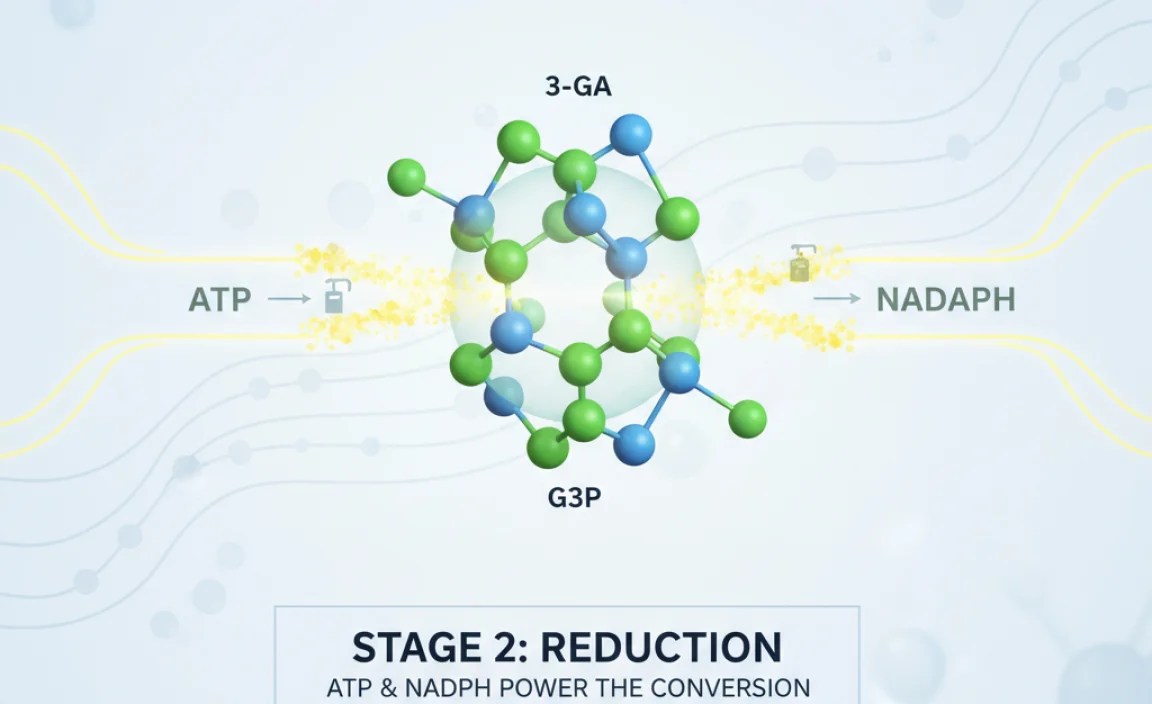
Now that we have 3-PGA, it’s time to reduce it using the energy from ATP and the reducing power of NADPH. Each molecule of 3-PGA receives a phosphate group from ATP, becoming 1,3-bisphosphoglycerate. Then, NADPH donates electrons to 1,3-bisphosphoglycerate, reducing it to glyceraldehyde-3-phosphate (G3P). G3P is a three-carbon sugar, and it’s the direct product of the Calvin Cycle. For every six molecules of CO2 that enter the cycle, twelve molecules of G3P are produced. However, only two of these G3P molecules are used to make glucose and other organic molecules. The remaining ten G3P molecules are used to regenerate RuBP.
This stage is like using energy to build something new. ATP provides the power, NADPH provides the building blocks, and together they transform 3-PGA into G3P.
Stage 3: Regeneration
To keep the Calvin Cycle running, we need to regenerate RuBP, the initial CO2 acceptor. This process involves a complex series of reactions that use ATP to rearrange the remaining ten G3P molecules into six molecules of RuBP. These RuBP molecules are then ready to accept more carbon dioxide and start the cycle all over again.
Think of this stage as recycling. We’re taking the leftover materials (G3P) and using them to create the starting material (RuBP) so we can continue the process.
The Overall Equation of the Calvin Cycle
To summarize, the overall equation of the Calvin Cycle is:
6 CO2 + 18 ATP + 12 NADPH + 12 H2O → C6H12O6 (glucose) + 18 ADP + 18 Pi + 12 NADP+ + 6 H+
This equation shows that for every six molecules of carbon dioxide that enter the cycle, one molecule of glucose is produced, along with byproducts that are recycled back into the light-dependent reactions.
What Happens to the G3P?
As we mentioned earlier, G3P is the direct product of the Calvin Cycle. But what happens to it after it’s produced? G3P can be used in several ways:
- Glucose Synthesis: Two molecules of G3P can combine to form one molecule of glucose, a simple sugar that plants use for energy.
- Sucrose Synthesis: Glucose can be converted into sucrose, another type of sugar that is transported throughout the plant to provide energy to other cells.
- Starch Synthesis: Glucose can be stored as starch, a complex carbohydrate that serves as a long-term energy reserve for the plant.
- Synthesis of Other Organic Molecules: G3P can also be used to synthesize other organic molecules, such as amino acids, lipids, and nucleotides, which are essential for plant growth and development.
The Role of Light-Dependent Reactions
The Calvin Cycle is closely linked to the light-dependent reactions of photosynthesis. The light-dependent reactions capture light energy and use it to produce ATP and NADPH, which are then used in the Calvin Cycle to fix carbon dioxide and produce sugar. The light-dependent reactions also produce oxygen as a byproduct. Therefore, photosynthesis is a two-stage process, with the light-dependent reactions providing the energy and reducing power needed for the Calvin Cycle to occur. To learn more about the light-dependent reactions, visit reputable sources like Science.gov.
Factors Affecting the Calvin Cycle
Several factors can affect the rate of the Calvin Cycle, including:
- Light Intensity: The light-dependent reactions provide the ATP and NADPH needed for the Calvin Cycle, so light intensity can indirectly affect the rate of carbon fixation.
- Carbon Dioxide Concentration: The availability of carbon dioxide is a limiting factor for the Calvin Cycle. If there is not enough carbon dioxide, the rate of carbon fixation will slow down.
- Temperature: Enzymes are sensitive to temperature, so the rate of the Calvin Cycle will be affected by temperature. The optimal temperature for the Calvin Cycle varies depending on the plant species.
- Water Availability: Water stress can reduce the rate of photosynthesis, including the Calvin Cycle, by causing the stomata (small pores on the leaves) to close, limiting carbon dioxide uptake.
The Importance of the Calvin Cycle
The Calvin Cycle is essential for life on Earth. It is the primary way that carbon dioxide is converted into organic molecules, which are the building blocks of all living things. Without the Calvin Cycle, there would be no plants, and without plants, there would be no animals (including humans!). The Calvin Cycle also plays a crucial role in regulating the Earth’s climate by removing carbon dioxide from the atmosphere.
Calvin Cycle vs. Krebs Cycle: What’s the Difference?
The Calvin Cycle and the Krebs Cycle are both metabolic pathways that are essential for life, but they have different functions and occur in different organisms.
Here’s a table summarizing the key differences:
| Feature | Calvin Cycle | Krebs Cycle (Citric Acid Cycle) |
|---|---|---|
| Purpose | Fixes carbon dioxide into sugar (glucose) | Oxidizes acetyl-CoA to produce energy carriers (NADH, FADH2) and carbon dioxide |
| Organisms | Plants, algae, and some bacteria (autotrophs) | Most living organisms (both autotrophs and heterotrophs) |
| Location | Stroma of chloroplasts | Mitochondrial matrix |
| Reactants | Carbon dioxide, ATP, NADPH | Acetyl-CoA, NAD+, FAD, GDP |
| Products | Glucose (G3P), ADP, NADP+ | Carbon dioxide, NADH, FADH2, GTP |
| Energy Source | ATP and NADPH from light-dependent reactions | Oxidation of fuel molecules (glucose, fatty acids, amino acids) |
| Oxygen Requirement | Indirectly requires oxygen (for light-dependent reactions) | Requires oxygen |
Real-World Applications and Research
Understanding the Calvin Cycle has significant implications for various fields, including:
- Agriculture: By optimizing the conditions for the Calvin Cycle, such as carbon dioxide concentration and temperature, we can increase crop yields and improve food security.
- Biofuels: Scientists are exploring ways to engineer algae and other photosynthetic organisms to produce biofuels more efficiently.
- Climate Change: Understanding the Calvin Cycle can help us develop strategies to remove carbon dioxide from the atmosphere and mitigate climate change.
- Synthetic Biology: Researchers are working to create artificial versions of the Calvin Cycle that could be used to produce valuable chemicals and materials.
Tips for Remembering the Calvin Cycle
The Calvin Cycle can seem complicated, but here are some tips to help you remember it:
- Focus on the Main Stages: Carbon Fixation, Reduction, and Regeneration.
- Remember the Key Players: RuBisCO, RuBP, ATP, NADPH, and G3P.
- Use Visual Aids: Draw a diagram of the Calvin Cycle and label the different stages and molecules.
- Relate it to Real Life: Think about how plants use the Calvin Cycle to make their own food and how this process is essential for life on Earth.
- Practice: Test your knowledge by answering questions and solving problems related to the Calvin Cycle.
The Future of Calvin Cycle Research
Research on the Calvin Cycle is ongoing, with scientists constantly seeking to improve our understanding of this essential process. Some of the current areas of research include:
- Improving RuBisCO Efficiency: RuBisCO is a relatively slow enzyme, and it can also react with oxygen instead of carbon dioxide, which reduces the efficiency of photosynthesis. Scientists are trying to engineer RuBisCO to be more efficient and less prone to reacting with oxygen.
- Developing Artificial Photosynthesis: Researchers are working to create artificial systems that can mimic the process of photosynthesis, including the Calvin Cycle. These systems could be used to produce clean energy and valuable chemicals.
- Engineering Plants for Climate Change: Scientists are exploring ways to engineer plants to be more efficient at capturing carbon dioxide from the atmosphere and storing it in their biomass. This could help to mitigate climate change.
FAQ About the Calvin Cycle
What exactly is the Calvin Cycle?
The Calvin Cycle is a series of chemical reactions that occur in plants and other photosynthetic organisms to convert carbon dioxide into glucose (sugar), using energy from ATP and NADPH.
Where does the Calvin Cycle happen?
It takes place in the stroma, which is the fluid-filled space inside chloroplasts, the plant cell’s compartments where photosynthesis occurs.
What are the three main stages of the Calvin Cycle?
The three stages are: 1) Carbon Fixation, where carbon dioxide is captured. 2) Reduction, where ATP and NADPH convert the fixed carbon into G3P. 3) Regeneration, where RuBP, the initial CO2 acceptor, is regenerated to keep the cycle going.
Why is RuBisCO so important?
RuBisCO is an enzyme that catalyzes the first major step of carbon fixation. It’s essential for the Calvin Cycle to start, making it one of the most abundant enzymes on Earth.
What happens to the G3P produced in the Calvin Cycle?
G3P is a three-carbon sugar that can be used to make glucose, sucrose, starch, and other organic molecules needed for plant growth and development.
How do the light-dependent reactions relate to the Calvin Cycle?
The light-dependent reactions provide the ATP and NADPH that the Calvin Cycle needs to fix carbon dioxide and produce sugar.
Can the Calvin Cycle be affected by environmental factors?
Yes, factors like light intensity, carbon dioxide concentration, temperature, and water availability can all affect the rate of the Calvin Cycle.
Conclusion
The Calvin Cycle is a fundamental process that underpins life on Earth. By converting carbon dioxide into sugars, it provides the energy and building blocks that plants and other organisms need to grow and thrive. Understanding the Calvin Cycle is essential for addressing challenges related to food security, climate change, and sustainable energy. So, the next time you see a plant, remember the amazing process happening inside its leaves – the Calvin Cycle, quietly and efficiently turning carbon dioxide into the fuel of life!
“`


