
What is the Pump Work of the Rankine Cycle? A Beginner’s Guide

The pump work in the Rankine cycle is the energy needed to increase the pressure of the liquid water entering the boiler. It’s a crucial part of the cycle that determines overall efficiency. Minimizing pump work helps maximize the net power output of the Rankine cycle.
Ever wondered how power plants turn steam into electricity? The Rankine cycle is a fundamental process behind it all. But sometimes, understanding the nitty-gritty details like “pump work” can feel like trying to inflate a tire with a hole in it! It seems complicated, but it’s actually quite straightforward when you break it down. Knowing what pump work is and how it affects the cycle is key to understanding how power plants work. Don’t worry, we’ll walk through it together, step by step. By the end of this article, you’ll have a solid grasp of pump work in the Rankine cycle. We’ll cover what it is, how it’s calculated, and why it matters. Let’s get started!
Understanding the Rankine Cycle

Before diving into pump work, let’s quickly recap the Rankine cycle itself. Think of it as a loop where water transforms into steam, does some work, and then returns to its original state. The Rankine cycle is the basic thermodynamic cycle used in most power plants. It converts heat into mechanical energy, which then generates electricity. Here’s a breakdown of the four main stages:
- Pump: Liquid water is pumped to a high pressure.
- Boiler: The high-pressure water enters a boiler and is converted into high-pressure steam.
- Turbine: The high-pressure steam expands through a turbine, generating electricity.
- Condenser: The steam is then condensed back into liquid water, ready to start the cycle again.
Each of these stages plays a vital role in the overall efficiency of the cycle. Now, let’s zoom in on the first stage: the pump.
What Exactly is Pump Work?
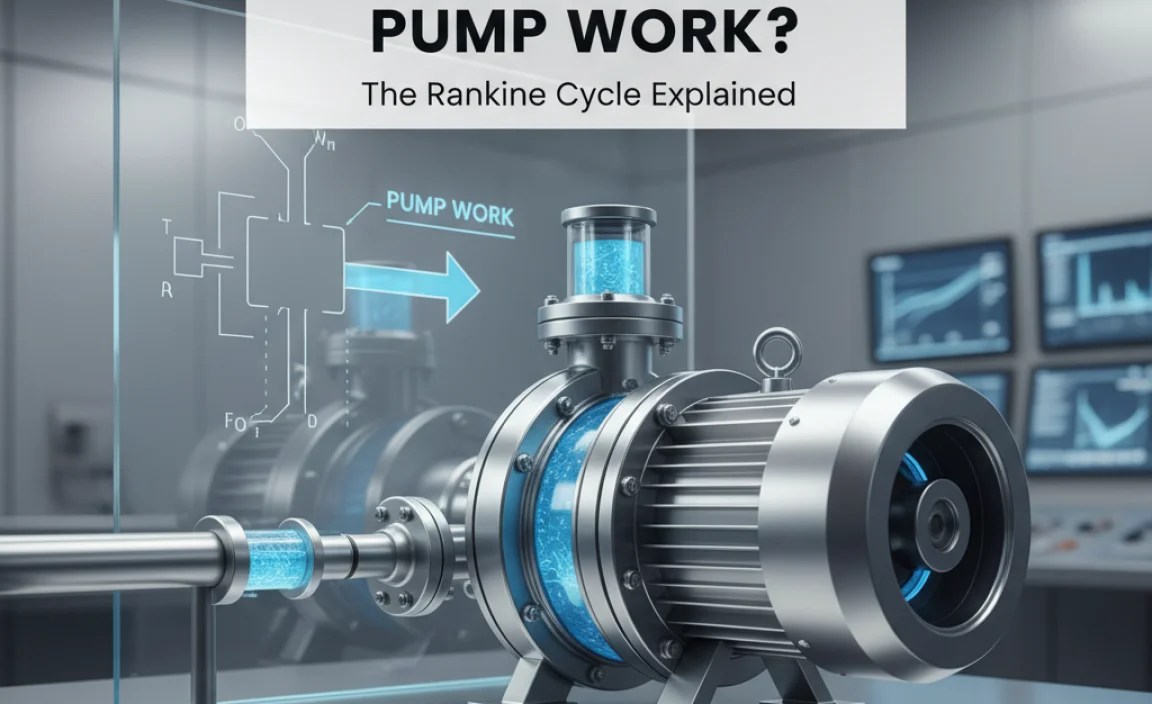
Pump work is the energy required to increase the pressure of the water before it enters the boiler. Imagine squeezing a bike pump: you’re putting in work to increase the air pressure. Similarly, the pump in the Rankine cycle increases the pressure of the water. This pressurized water is then ready to be heated into steam in the boiler. The pump increases the pressure of the water from the condenser pressure to the boiler pressure. High pressure is needed in the boiler to efficiently create high-pressure, high-temperature steam. This high-energy steam is what drives the turbine to generate electricity. Without the pump, the Rankine cycle wouldn’t be possible.
In simpler terms, pump work is the “effort” the pump exerts to prepare the water for the next stage.
Why is Pump Work Important?
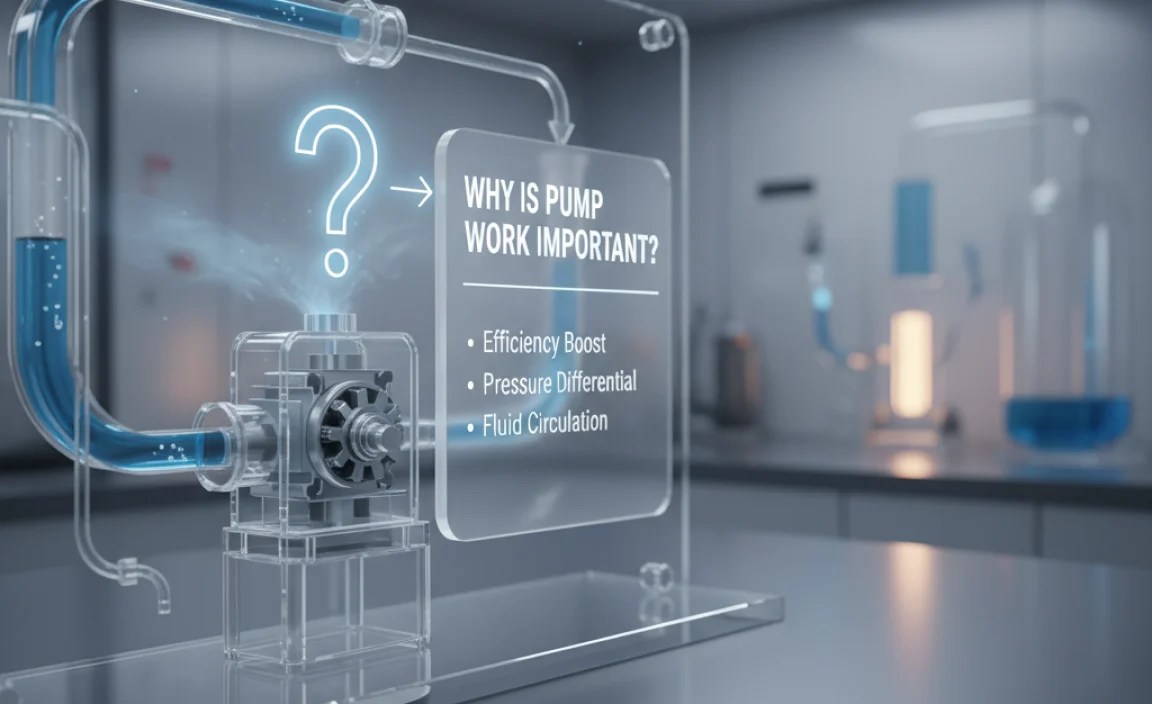
You might be thinking, “Okay, so the pump uses some energy. Why should I care?” Well, pump work, although relatively small compared to the turbine work, directly affects the overall efficiency of the Rankine cycle. Here’s why it matters:
- Efficiency: The more energy the pump consumes, the less energy is available for generating electricity. Minimizing pump work increases the cycle’s overall efficiency.
- Net Power Output: The net power output of the Rankine cycle is the difference between the turbine work (power generated) and the pump work (power consumed). Reducing pump work directly increases the net power output.
- Cost Savings: Lower pump work means lower energy consumption, which translates to lower operating costs for the power plant.
Essentially, reducing pump work is like making your bike more aerodynamic – it might not seem like a huge difference, but it adds up over time and improves overall performance.
How is Pump Work Calculated?
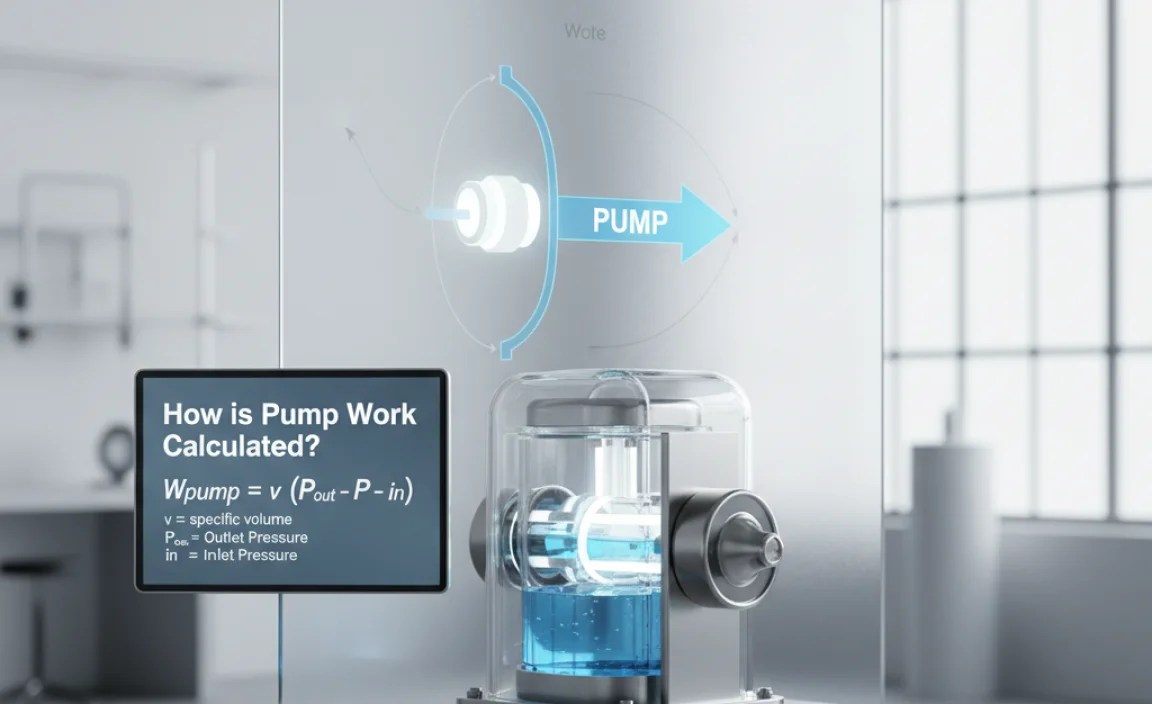
Now for the math part! Don’t worry, we’ll keep it simple. The formula for calculating pump work is:
Wpump = v * (P2 – P1)
Where:
- Wpump is the pump work (usually in kJ/kg or BTU/lbm)
- v is the specific volume of the liquid water (volume per unit mass, usually in m3/kg or ft3/lbm)
- P2 is the pressure of the water after the pump (high pressure)
- P1 is the pressure of the water before the pump (low pressure)
Let’s break this down further:
- Specific Volume (v): This value tells you how much space a certain amount of water occupies. It’s crucial because liquids are nearly incompressible, meaning their volume doesn’t change much with pressure. You can usually find this value in thermodynamic tables for water at a specific temperature.
- Pressure Difference (P2 – P1): This is the increase in pressure caused by the pump. A larger pressure difference means the pump has to work harder.
Example:
Let’s say we have water with a specific volume (v) of 0.001 m3/kg. The pressure before the pump (P1) is 10 kPa, and the pressure after the pump (P2) is 10,000 kPa. Then:
Wpump = 0.001 m3/kg * (10,000 kPa – 10 kPa) = 0.001 m3/kg * 9990 kPa = 9.99 kJ/kg
So, the pump work in this case is approximately 9.99 kJ/kg.
Factors Affecting Pump Work
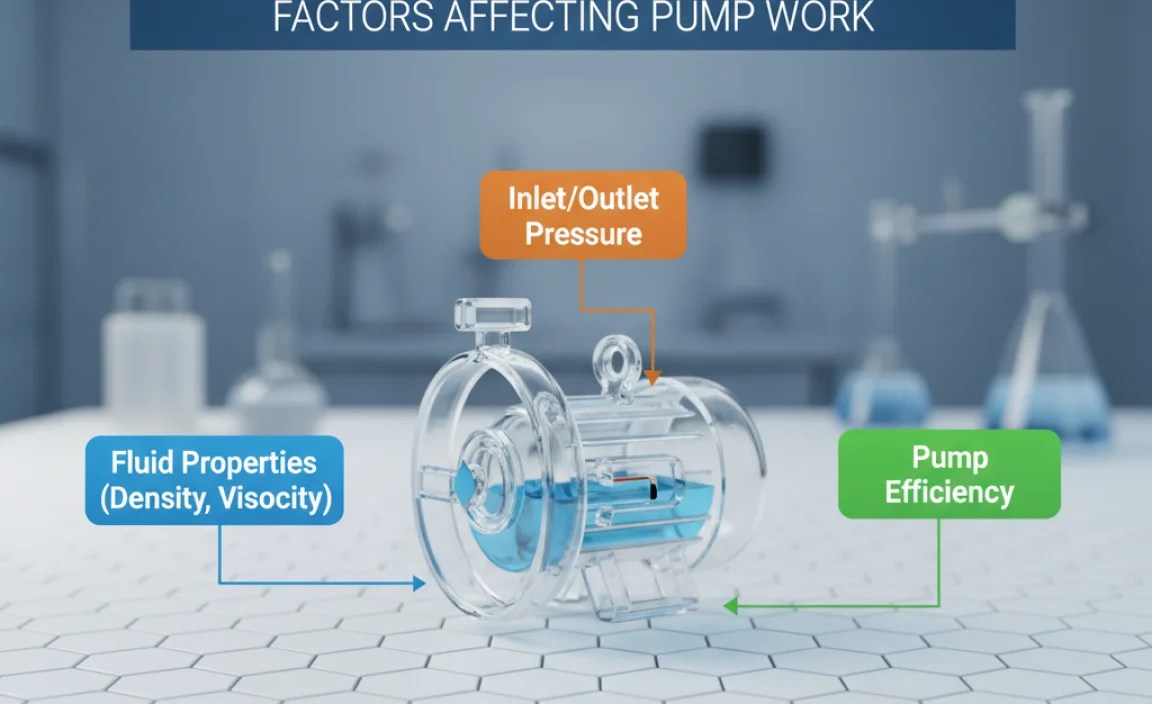
Several factors can influence the amount of pump work required in the Rankine cycle. Understanding these factors can help optimize the cycle’s performance.
- Pressure Difference: As the formula shows, the larger the pressure difference between the condenser and the boiler, the more pump work is needed.
- Specific Volume: The specific volume of the water also plays a role. Although water is generally incompressible, its specific volume does change slightly with temperature.
- Pump Efficiency: Real-world pumps aren’t perfectly efficient. Some energy is lost due to friction and other factors. A less efficient pump will require more energy to achieve the same pressure increase.
How to Minimize Pump Work
Reducing pump work can lead to significant improvements in the Rankine cycle’s efficiency. Here are some strategies to minimize it:
- Reduce Pressure Difference: While you can’t eliminate the pressure difference entirely (it’s necessary for the cycle to function), optimizing the boiler and condenser pressures can help minimize it.
- Improve Pump Efficiency: Using high-efficiency pumps can significantly reduce energy consumption. Regular maintenance and timely replacements are essential.
- Maintain Optimal Temperature: Keeping the water temperature within the designed range can help minimize the specific volume and, consequently, the pump work.
Real-World Applications
The Rankine cycle, and therefore pump work, is a critical component of many power generation systems. Here are a few examples:
- Coal-Fired Power Plants: These plants use the Rankine cycle to convert the heat from burning coal into electricity.
- Nuclear Power Plants: Nuclear reactors generate heat, which is then used in a Rankine cycle to produce electricity.
- Concentrated Solar Power (CSP) Plants: CSP plants use mirrors to concentrate sunlight and generate heat, which is then used in a Rankine cycle.
- Biomass Power Plants: Similar to coal-fired plants, biomass power plants burn organic matter to generate heat for the Rankine cycle.
- Geothermal Power Plants: These plants tap into underground sources of heat to drive the Rankine cycle.
Advanced Concepts: Reheat and Regenerative Rankine Cycles
To further enhance the efficiency of the Rankine cycle, engineers often employ advanced techniques like reheat and regeneration. These modifications aim to extract more work from the steam and reduce energy losses.
Reheat Rankine Cycle
In a reheat Rankine cycle, the steam is expanded in the turbine in two stages. After the first stage, the steam is sent back to the boiler to be reheated before entering the second turbine stage. This increases the average temperature at which heat is added to the cycle, which improves efficiency. The steam is reheated to avoid excessive moisture content at the turbine exit.
Regenerative Rankine Cycle
The regenerative Rankine cycle uses a technique called feedwater heating to improve efficiency. Steam is extracted from the turbine at various points and used to heat the feedwater before it enters the boiler. This reduces the amount of heat that needs to be added in the boiler, thus improving the cycle’s thermal efficiency.
These modifications, while more complex, illustrate the ongoing efforts to optimize the Rankine cycle and improve power plant efficiency.
The Role of Pumps in Different Rankine Cycle Configurations
The basic Rankine cycle uses one main pump to increase the pressure of the water before it enters the boiler. However, in more advanced configurations like the regenerative Rankine cycle, additional pumps may be used.
Basic Rankine Cycle
In the basic Rankine cycle, a single pump is used to increase the pressure of the liquid water exiting the condenser. This pump must be capable of handling the entire flow rate of the cycle and delivering it at the high pressure required by the boiler.
Regenerative Rankine Cycle
In a regenerative Rankine cycle, multiple pumps may be used to handle the feedwater heating process. For example, condensate pumps are used to move the condensate from the condenser to the feedwater heaters, and boiler feed pumps are used to increase the pressure of the feedwater before it enters the boiler. These pumps work together to ensure that the feedwater is heated efficiently and delivered to the boiler at the correct pressure and temperature.
Here’s a simple table summarizing the key differences in pump usage between the basic and regenerative Rankine cycles:
| Cycle Type | Number of Pumps | Pump Function |
|---|---|---|
| Basic Rankine Cycle | One | Increases the pressure of the liquid water exiting the condenser |
| Regenerative Rankine Cycle | Multiple | Moves condensate from the condenser to feedwater heaters; increases the pressure of feedwater before it enters the boiler |
Troubleshooting Pump Problems
Like any mechanical component, pumps in the Rankine cycle can experience problems. Here are some common issues and their potential solutions:
- Cavitation: This occurs when the pressure at the pump inlet drops too low, causing vapor bubbles to form. These bubbles collapse violently, damaging the pump. Solutions include increasing the inlet pressure or reducing the pump speed.
- Overheating: Overheating can be caused by insufficient lubrication, excessive pump speed, or a blockage in the system. Solutions include checking and replenishing lubrication, reducing pump speed, and clearing any blockages.
- Vibration: Excessive vibration can be caused by misalignment, worn bearings, or cavitation. Solutions include realigning the pump, replacing worn bearings, and addressing cavitation issues.
- Reduced Flow Rate: A reduced flow rate can be caused by a clogged impeller, worn pump components, or a blockage in the system. Solutions include cleaning or replacing the impeller, replacing worn components, and clearing any blockages.
Regular maintenance and monitoring can help prevent these problems and ensure the pump operates efficiently and reliably.
FAQ: Understanding Pump Work in the Rankine Cycle
Let’s tackle some common questions about pump work in the Rankine cycle.
What is the ideal pump work in the Rankine cycle?
Ideally, pump work should be as low as possible to maximize the cycle’s efficiency. In an ideal Rankine cycle, the pump work is reversible and adiabatic (isentropic), meaning there are no losses due to friction or heat transfer.
How does pump efficiency affect the Rankine cycle?
Pump efficiency directly impacts the overall efficiency of the Rankine cycle. A less efficient pump requires more energy to achieve the same pressure increase, reducing the net power output and overall efficiency of the cycle.
Can pump work be negative?
No, pump work is always positive. It represents the energy input required to increase the pressure of the water. A negative value would imply that the pump is generating energy, which is not possible.
Why is water used as the working fluid in the Rankine cycle?
Water is a popular choice because it is readily available, inexpensive, and has excellent thermodynamic properties. Its high heat capacity and large enthalpy of vaporization make it well-suited for transferring heat in the cycle.
How does the condenser pressure affect pump work?
The condenser pressure is the inlet pressure to the pump (P1). A lower condenser pressure will increase the pressure difference (P2 – P1), which will increase pump work.
What are some alternative working fluids for the Rankine cycle?
While water is most common, other working fluids like organic fluids (e.g., refrigerants) are used in Organic Rankine Cycles (ORC). These fluids are chosen for their specific thermodynamic properties, especially in low-temperature heat source applications.
How often should pumps in a Rankine cycle system be serviced?
Pump service intervals depend on operating conditions and manufacturer recommendations. Regular checks (monthly or quarterly) should include visual inspections for leaks, vibration, and noise. Major overhauls are typically required every few years, or as indicated by performance monitoring.
Conclusion
Understanding pump work is essential for grasping the intricacies of the Rankine cycle and its role in power generation. By minimizing pump work, power plants can improve efficiency, reduce costs, and generate more electricity. While it might seem like a small piece of the puzzle, optimizing pump work contributes significantly to the overall performance and sustainability of power generation systems. Just like keeping your bike tires properly inflated, paying attention to the details makes a big difference in the long run. Keep exploring and stay curious!
“`


