
How to Calculate Cycle Per Minute for a Diaphragm Pump

Quick Summary: To calculate the cycle per minute (CPM) of a diaphragm pump, divide the pump’s flow rate (in gallons per minute or liters per minute) by the pump’s displacement per cycle (in gallons or liters). This tells you how many complete back-and-forth motions the diaphragm needs to make each minute to achieve the desired flow rate. Understanding CPM helps optimize pump performance and prevent wear.
Ever wondered how much work your diaphragm pump is *really* doing? It’s easy to focus on the flow rate—how much liquid it’s moving. But knowing the cycle per minute (CPM) is key to understanding your pump’s efficiency and lifespan. A pump running too fast will wear out quickly. Too slow, and you’re not getting the performance you need. It sounds complicated, but don’t worry! We’ll break down exactly how to calculate CPM, step by step, so you can keep your pump running smoothly and efficiently. Ready to dive in?
Understanding Diaphragm Pumps

Before we jump into the math, let’s quickly cover what a diaphragm pump is and why CPM matters.
What is a Diaphragm Pump?
A diaphragm pump (also known as a membrane pump) is a type of positive displacement pump that uses a flexible diaphragm to move fluids. The diaphragm reciprocates, creating a chamber that expands to draw fluid in and then contracts to push fluid out.
Here’s a simplified breakdown of how it works:
- Suction Stroke: The diaphragm pulls back, increasing the volume of the pump chamber and creating a vacuum. This vacuum sucks fluid into the chamber through an inlet valve.
- Discharge Stroke: The diaphragm pushes forward, decreasing the volume of the pump chamber and increasing the pressure. This pressure forces the fluid out of the chamber through an outlet valve.
This cycle repeats continuously, providing a consistent flow of fluid.
Why is Cycle Per Minute (CPM) Important?
Knowing the CPM of your diaphragm pump is crucial for several reasons:
- Performance Optimization: Ensures the pump is operating within its designed parameters for optimal flow rate and pressure.
- Preventing Premature Wear: Operating at excessive CPM can lead to increased friction, heat, and stress on the diaphragm and other components, shortening the pump’s lifespan.
- Energy Efficiency: Running the pump at the correct CPM can minimize energy consumption.
- Troubleshooting: Unexpected changes in CPM can indicate potential problems with the pump, such as leaks, blockages, or diaphragm failure.
Gathering the Necessary Information

To calculate CPM, you’ll need two key pieces of information:
- Flow Rate (Q): The volume of fluid the pump delivers per unit of time. This is typically measured in gallons per minute (GPM) or liters per minute (LPM).
- Displacement per Cycle (Vd): The volume of fluid the pump moves during one complete cycle (one back-and-forth motion of the diaphragm). This is typically measured in gallons per cycle (G/cycle) or liters per cycle (L/cycle).
Finding the Flow Rate (Q)
The flow rate is usually specified in the pump’s documentation or on a nameplate attached to the pump. Look for terms like “flow rate,” “capacity,” or “output.” If you can’t find it there, you might need to consult the manufacturer’s website or contact their technical support.
If you need to measure the flow rate yourself, here’s how:
- Collect the Fluid: Use a container of known volume (e.g., a 5-gallon bucket or a 10-liter container).
- Time the Collection: Measure how long it takes for the pump to fill the container.
- Calculate the Flow Rate: Divide the volume of the container by the time it took to fill it. Make sure to convert the time into minutes.
Example: If it takes 30 seconds (0.5 minutes) to fill a 5-gallon bucket, the flow rate is 5 gallons / 0.5 minutes = 10 GPM.
Finding the Displacement per Cycle (Vd)
The displacement per cycle is also usually specified in the pump’s documentation. Look for terms like “displacement,” “stroke volume,” or “volume per cycle.” If you can’t find it, contact the manufacturer.
In some cases, you might need to calculate the displacement per cycle based on the pump’s geometry and stroke length. However, this is more complex and typically requires detailed technical specifications.
Calculating Cycle Per Minute (CPM)

Once you have the flow rate (Q) and the displacement per cycle (Vd), the calculation is simple:
CPM = Q / Vd
Where:
- CPM is the cycle per minute
- Q is the flow rate (in GPM or LPM)
- Vd is the displacement per cycle (in G/cycle or L/cycle)
Example Calculations
Let’s go through a few examples to illustrate the process.
Example 1: Using US Units (GPM and G/cycle)
Suppose you have a diaphragm pump with a flow rate of 15 GPM and a displacement per cycle of 0.1 G/cycle.
CPM = 15 GPM / 0.1 G/cycle = 150 cycles per minute
This means the diaphragm needs to complete 150 back-and-forth motions every minute to achieve a flow rate of 15 GPM.
Example 2: Using Metric Units (LPM and L/cycle)
Suppose you have a diaphragm pump with a flow rate of 30 LPM and a displacement per cycle of 0.2 L/cycle.
CPM = 30 LPM / 0.2 L/cycle = 150 cycles per minute
Again, the diaphragm needs to complete 150 cycles every minute to achieve a flow rate of 30 LPM.
Example 3: Calculating CPM from Measured Flow Rate
You’ve measured the flow rate of your pump to be 8 GPM by timing how long it takes to fill a container. The pump’s documentation states a displacement of 0.08 G/cycle.
CPM = 8 GPM / 0.08 G/cycle = 100 cycles per minute.
Practical Considerations and Adjustments

While the basic formula is straightforward, there are a few practical considerations to keep in mind.
Pump Efficiency
The calculated CPM assumes 100% pump efficiency, which is rarely the case in real-world scenarios. Factors like wear, fluid viscosity, and backpressure can reduce the pump’s actual flow rate.
To account for efficiency, you can introduce an efficiency factor (E) into the equation:
CPM = Q / (Vd * E)
The efficiency factor is typically expressed as a decimal (e.g., 0.8 for 80% efficiency). If you don’t know the exact efficiency, you can estimate it based on the pump’s condition and operating environment. A new, well-maintained pump might have an efficiency of 90% or higher, while an older, worn pump might be closer to 70% or lower.
Variable Speed Drives (VSDs)
Many modern diaphragm pumps are equipped with variable speed drives (VSDs) that allow you to adjust the motor speed and, consequently, the CPM. This gives you precise control over the flow rate and allows you to optimize the pump’s performance for different applications.
If your pump has a VSD, you can use the calculated CPM as a starting point and then fine-tune the speed based on your specific needs. Monitor the pump’s performance and adjust the speed until you achieve the desired flow rate and pressure.
Fluid Characteristics
The type of fluid being pumped can also affect the CPM. Highly viscous fluids will require more force to move, which can reduce the pump’s flow rate and increase the required CPM. Similarly, fluids containing solids or abrasive particles can accelerate wear on the diaphragm and other components, requiring more frequent maintenance.
Troubleshooting CPM Issues
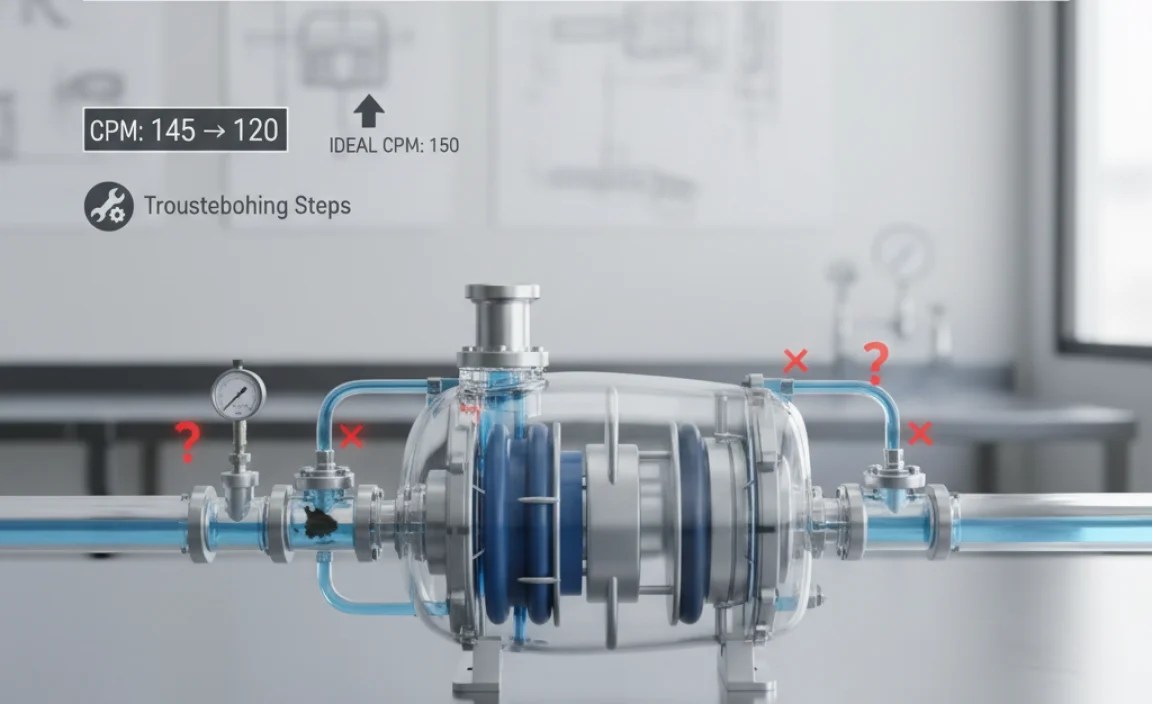
If you notice that your pump’s CPM is significantly different from what you expect, there could be several reasons:
- Leaks: A leak in the pump or piping system will reduce the flow rate and increase the required CPM.
- Blockages: A blockage in the inlet or outlet line will restrict the flow and also increase the required CPM.
- Diaphragm Failure: A damaged or worn diaphragm will reduce the pump’s displacement per cycle and affect the CPM.
- Incorrect Settings: If your pump has a VSD, make sure the speed is set correctly.
To troubleshoot CPM issues, start by inspecting the pump and piping system for leaks, blockages, and damage. Check the diaphragm for signs of wear or failure. If necessary, consult the pump’s manual or contact the manufacturer for assistance.
Tools for Measuring and Monitoring CPM
While you can calculate CPM manually, several tools can help you measure and monitor it more accurately and conveniently.
- Tachometer: A tachometer is a device that measures the rotational speed of a shaft or disk. You can use a tachometer to measure the speed of the pump’s motor or drive shaft and then correlate that to the CPM.
- Flow Meter: A flow meter measures the flow rate of the fluid being pumped. By monitoring the flow rate, you can ensure that the pump is operating at the desired CPM.
- Pressure Gauge: A pressure gauge measures the pressure of the fluid being pumped. Monitoring the pressure can help you identify potential problems with the pump, such as leaks or blockages, that can affect the CPM.
- Data Logger: A data logger is a device that records data over time. You can use a data logger to track the pump’s CPM, flow rate, and pressure and then analyze the data to identify trends and potential issues.
Diaphragm Pump Maintenance Tips
Proper maintenance is essential for keeping your diaphragm pump running efficiently and reliably. Here are a few tips:
- Regular Inspections: Inspect the pump and piping system regularly for leaks, blockages, and damage.
- Diaphragm Replacement: Replace the diaphragm according to the manufacturer’s recommendations or when you notice signs of wear or failure.
- Lubrication: Lubricate the pump’s moving parts as needed.
- Cleaning: Clean the pump and piping system regularly to remove debris and buildup.
- Proper Storage: Store the pump in a clean, dry environment when not in use.
Diaphragm Pump: Advantages and Disadvantages
Diaphragm pumps offer several advantages but also come with some disadvantages. Here’s a quick overview:
| Advantages | Disadvantages |
|---|---|
| Can handle a wide range of fluids, including abrasive and corrosive materials. | Pulsating flow may require dampeners for certain applications. |
| Self-priming capabilities. | Diaphragm material may limit chemical compatibility. |
| Can run dry without damage. | Maintenance required for diaphragms and valves. |
| Relatively low maintenance compared to some other pump types. | Can be noisier than some other pump designs. |
| Good for applications requiring variable flow rates. |
Choosing the Right Diaphragm Pump
Selecting the right diaphragm pump for your application is crucial for optimal performance and longevity. Consider the following factors when making your decision:
- Flow Rate: Determine the required flow rate for your application and choose a pump that can deliver it.
- Pressure: Determine the required pressure for your application and choose a pump that can generate it.
- Fluid Compatibility: Ensure that the pump’s materials are compatible with the fluid being pumped.
- Temperature: Choose a pump that can operate within the required temperature range.
- Viscosity: Consider the viscosity of the fluid being pumped and choose a pump that can handle it.
- Solids Content: If the fluid contains solids, choose a pump that can handle them without clogging or damage.
- Maintenance Requirements: Consider the maintenance requirements of the pump and choose one that is easy to maintain.
- Cost: Consider the cost of the pump and choose one that fits your budget.
FAQ: Diaphragm Pump Cycle Rate
Here are some frequently asked questions about cycle per minute and diaphragm pumps:
- What does CPM stand for in diaphragm pumps?
- CPM stands for Cycles Per Minute. It indicates how many complete back-and-forth strokes the diaphragm makes in one minute.
- Why is knowing the CPM important for my diaphragm pump?
- Knowing the CPM helps you optimize the pump’s performance, prevent premature wear, ensure energy efficiency, and troubleshoot potential issues.
- Where can I find the flow rate and displacement per cycle for my pump?
- These values are usually found in the pump’s documentation, on a nameplate attached to the pump, or on the manufacturer’s website.
- What happens if my pump’s CPM is too high?
- Operating at an excessively high CPM can lead to increased friction, heat, and stress on the diaphragm and other components, shortening the pump’s lifespan.
- Can I adjust the CPM of my diaphragm pump?
- Yes, many modern diaphragm pumps are equipped with variable speed drives (VSDs) that allow you to adjust the motor speed and, consequently, the CPM.
- What are some common issues that can affect the CPM of my pump?
- Leaks, blockages, diaphragm failure, and incorrect settings (if your pump has a VSD) can all affect the CPM.
- How often should I maintain my diaphragm pump?
- Regular inspections and maintenance are essential for keeping your diaphragm pump running efficiently and reliably. Follow the manufacturer’s recommendations for maintenance intervals.
Conclusion
Calculating the cycle per minute (CPM) of your diaphragm pump is a simple but powerful way to understand and optimize its performance. By knowing the flow rate and displacement per cycle, you can easily calculate the CPM and ensure that your pump is operating within its designed parameters. This not only improves efficiency and extends the pump’s lifespan but also helps you troubleshoot potential problems before they become major issues. So, grab your calculator, check your pump’s specs, and start calculating! Your pump (and your wallet) will thank you.
“`


