
How to Calculate the Life Cycle Cost of a Pump: A Simple Guide

Calculating the life cycle cost (LCC) of a pump involves adding up all the expenses you’ll face during its entire lifespan, from buying it to eventually replacing it. This includes the initial purchase price, energy costs, maintenance, repairs, and disposal. Knowing the LCC helps you make smarter decisions, saving you money in the long run by choosing the most cost-effective option, not just the cheapest upfront.
Ever feel like you’re constantly throwing money at your bike pump? Maybe you bought a cheap one that keeps breaking, or perhaps a high-end model with expensive replacement parts. Figuring out the true cost of a pump isn’t just about the price tag. It’s about how much it will cost you over its entire life. This is what we call the life cycle cost, or LCC. Don’t worry; it’s not as complicated as it sounds! This guide will walk you through calculating the LCC of your bike pump, so you can make the best choice for your needs and budget. Let’s get started!
Understanding Life Cycle Cost (LCC)

Life Cycle Cost (LCC) is a comprehensive approach to evaluating the total expenses associated with an asset, like a bike pump, throughout its entire lifespan. Unlike simply looking at the initial purchase price, LCC considers all costs, including:
- Initial Cost: The purchase price of the pump.
- Energy Costs: The cost of electricity if it’s an electric pump, or the energy you expend using a manual pump (though this is harder to quantify in monetary terms!).
- Maintenance Costs: Regular servicing, cleaning, and replacement of wearable parts.
- Repair Costs: Unexpected repairs due to breakdowns or damage.
- Downtime Costs: The cost of not being able to use your pump when it’s out of service.
- Disposal Costs: The cost of disposing of the pump responsibly at the end of its life.
By considering all these factors, LCC provides a more accurate picture of the true cost of ownership, allowing you to make informed decisions and choose the most cost-effective option in the long run.
Why Calculate the Life Cycle Cost?

Calculating the LCC offers several key advantages:
- Cost Savings: Identifying hidden costs helps you avoid expensive surprises down the road.
- Informed Decisions: You can compare different pump models and choose the one that offers the best value over its lifetime.
- Budgeting: LCC helps you budget for maintenance, repairs, and eventual replacement.
- Performance Optimization: Understanding the cost drivers can motivate you to optimize pump usage and maintenance practices.
Steps to Calculate the Life Cycle Cost of a Pump

Here’s a step-by-step guide to calculating the LCC of your bike pump:
Step 1: Gather Your Data
The first step is to gather all the necessary data. This includes:
- Initial Cost (Ci): The purchase price of the pump.
- Energy Costs (Ce): If it’s an electric pump, estimate the annual electricity consumption and cost. For manual pumps, this can be considered negligible in terms of direct monetary cost.
- Maintenance Costs (Cm): Estimate the annual cost of maintenance, including cleaning, lubrication, and replacement of wearable parts like seals and hoses.
- Repair Costs (Cr): Estimate the annual cost of unexpected repairs. This can be based on historical data or industry averages.
- Downtime Costs (Cd): Estimate the cost of not being able to use your pump when it’s out of service. This might include the cost of alternative transportation or the inconvenience of not being able to ride your bike.
- Lifespan (N): Estimate the expected lifespan of the pump in years.
- Discount Rate (i): This is the rate used to discount future costs to their present value. A common discount rate is between 3% and 5%.
- Salvage Value (S): The estimated value of the pump at the end of its lifespan (often zero).
Step 2: Estimate Energy Costs (Ce)
If you’re using an electric pump, you need to estimate the annual energy consumption and cost. Here’s how:
- Determine Power Consumption: Find the pump’s power rating in watts (W).
- Estimate Usage: Estimate how many hours per year you use the pump.
- Calculate Energy Consumption: Multiply the power consumption by the usage hours to get the annual energy consumption in watt-hours (Wh). Then, divide by 1000 to convert to kilowatt-hours (kWh).
- Calculate Energy Cost: Multiply the annual energy consumption in kWh by the cost of electricity per kWh. You can find this information on your electricity bill.
Example:
Let’s say your electric pump has a power rating of 150W, and you use it for 1 hour per week (52 hours per year). The cost of electricity is $0.15 per kWh.
- Annual energy consumption: (150W * 52 hours) / 1000 = 7.8 kWh
- Annual energy cost: 7.8 kWh * $0.15/kWh = $1.17
Step 3: Estimate Maintenance Costs (Cm)
Maintenance costs include the cost of regular servicing, cleaning, and replacement of wearable parts. Consider the following:
- Cleaning Supplies: Cost of cleaning solutions and brushes.
- Lubrication: Cost of lubricants for moving parts.
- Replacement Parts: Cost of replacing seals, hoses, and other wearable parts.
- Labor: If you hire someone to perform maintenance, include the cost of labor.
Estimate the annual cost of maintenance based on your usage and the manufacturer’s recommendations. Keep records of maintenance expenses to improve your estimates over time.
Step 4: Estimate Repair Costs (Cr)
Repair costs are the costs of unexpected repairs due to breakdowns or damage. This can be difficult to predict, but you can use historical data or industry averages to estimate the annual repair cost. Consider the following:
- Frequency of Repairs: How often do you expect the pump to break down?
- Cost of Repairs: How much will it cost to repair the pump each time it breaks down?
- Warranty: Does the pump have a warranty that covers some or all of the repair costs?
Factor in the likelihood of repairs and the potential cost to arrive at an annual estimate. Lower quality pumps might have higher repair costs.
Step 5: Estimate Downtime Costs (Cd)
Downtime costs are the costs of not being able to use your pump when it’s out of service. This can include:
- Inconvenience: The cost of not being able to ride your bike due to a flat tire.
- Alternative Transportation: The cost of using alternative transportation while the pump is being repaired.
- Lost Productivity: If you use the pump for commercial purposes, the cost of lost productivity due to downtime.
Estimate the annual downtime cost based on the frequency and duration of downtime events. This can be a subjective estimate, but it’s important to consider the impact of downtime on your overall costs.
Step 6: Determine the Lifespan (N)
The lifespan of a pump is the expected number of years it will last before it needs to be replaced. This can vary depending on the quality of the pump, the frequency of use, and the maintenance practices. Consider the following:
- Manufacturer’s Recommendations: Check the manufacturer’s recommendations for the expected lifespan of the pump.
- Historical Data: If you’ve used similar pumps in the past, consider how long they lasted.
- Usage: The more frequently you use the pump, the shorter its lifespan is likely to be.
Estimate the lifespan of the pump based on these factors. A high-quality pump that is well-maintained may last longer than a cheaper pump that is used frequently and not properly maintained.
Step 7: Choose a Discount Rate (i)
The discount rate is the rate used to discount future costs to their present value. This reflects the time value of money – the idea that money today is worth more than the same amount of money in the future due to its potential earning capacity.
A common discount rate is between 3% and 5%. The choice of discount rate can significantly impact the LCC calculation, so it’s important to choose a rate that reflects your investment opportunities and risk tolerance. You can consult financial resources or experts to help you choose an appropriate discount rate.
Investopedia defines Discount Rate as the interest rate used to determine the present value of future cash flows in a discounted cash flow (DCF) analysis. A company’s weighted average cost of capital (WACC) is often used as the discount rate.
Step 8: Calculate the Present Value of Each Cost Component
To calculate the LCC, you need to discount all future costs to their present value. The present value (PV) of a future cost is the amount of money you would need to invest today at the discount rate to have that amount of money in the future. Here’s the formula for calculating the present value of a single future cost:
PV = C / (1 + i)^n
Where:
- PV = Present Value
- C = Future Cost
- i = Discount Rate
- n = Number of Years in the Future
You need to calculate the present value of each cost component (energy, maintenance, repair, and downtime) for each year of the pump’s lifespan. This can be done using a spreadsheet or a financial calculator.
Step 9: Calculate the Life Cycle Cost (LCC)
Once you’ve calculated the present value of each cost component, you can calculate the LCC by summing all the present values, including the initial cost and subtracting the present value of the salvage value:
LCC = Ci + PV(Ce) + PV(Cm) + PV(Cr) + PV(Cd) – PV(S)
Where:
- LCC = Life Cycle Cost
- Ci = Initial Cost
- PV(Ce) = Present Value of Energy Costs
- PV(Cm) = Present Value of Maintenance Costs
- PV(Cr) = Present Value of Repair Costs
- PV(Cd) = Present Value of Downtime Costs
- PV(S) = Present Value of Salvage Value
Example Calculation
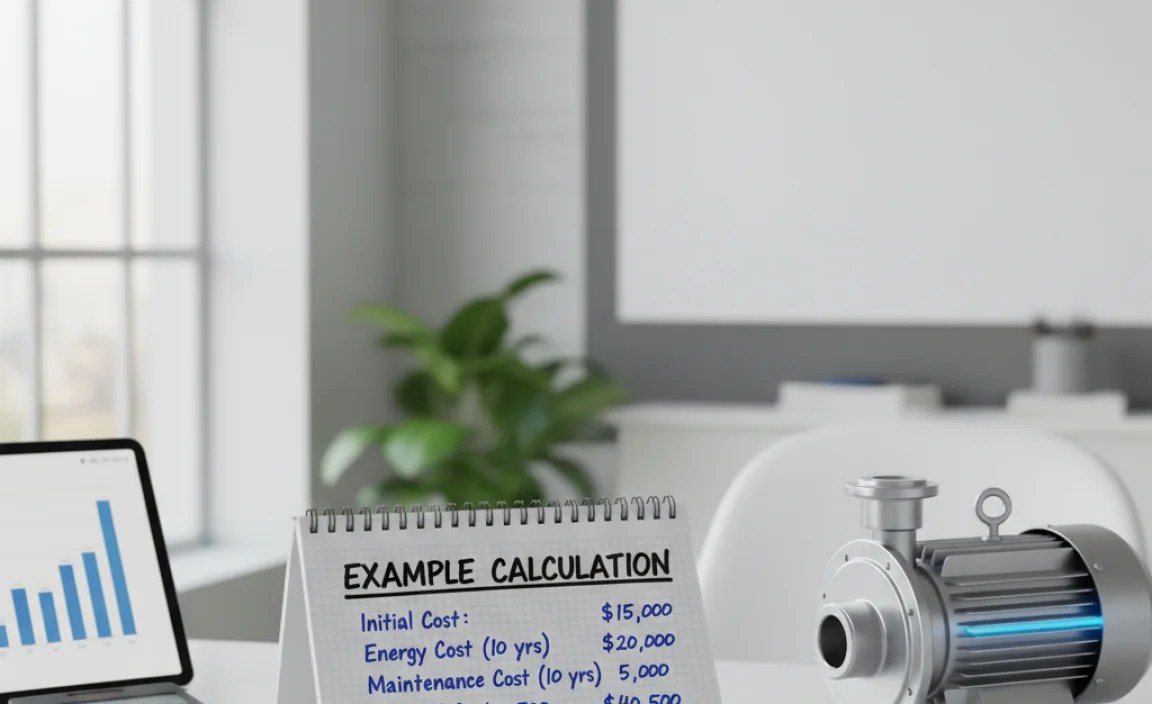
Let’s say you’re comparing two bike pumps: Pump A and Pump B.
Pump A:
- Initial Cost: $50
- Annual Energy Cost: $0 (Manual Pump)
- Annual Maintenance Cost: $10
- Annual Repair Cost: $5
- Annual Downtime Cost: $2
- Lifespan: 5 years
- Discount Rate: 5%
- Salvage Value: $0
Pump B:
- Initial Cost: $100
- Annual Energy Cost: $0 (Manual Pump)
- Annual Maintenance Cost: $5
- Annual Repair Cost: $2
- Annual Downtime Cost: $1
- Lifespan: 10 years
- Discount Rate: 5%
- Salvage Value: $0
Here’s a table showing the present value of each cost component for each pump:
| Cost Component | Pump A | Pump B |
|---|---|---|
| Initial Cost | $50 | $100 |
| Present Value of Energy Costs | $0 | $0 |
| Present Value of Maintenance Costs | $43.29 | $38.61 |
| Present Value of Repair Costs | $21.65 | $15.44 |
| Present Value of Downtime Costs | $8.66 | $7.72 |
| Present Value of Salvage Value | $0 | $0 |
| Life Cycle Cost | $123.60 | $161.77 |
In this example, Pump A has a lower life cycle cost ($123.60) than Pump B ($161.77), even though Pump B has a higher initial cost. This is because Pump A has lower maintenance, repair, and downtime costs over its lifespan.
Tips for Reducing Life Cycle Costs

Here are some tips for reducing the life cycle costs of your bike pump:
- Choose a High-Quality Pump: Investing in a high-quality pump may cost more upfront, but it can save you money in the long run due to its durability and reliability.
- Perform Regular Maintenance: Regular maintenance can prevent breakdowns and extend the lifespan of your pump.
- Use the Pump Properly: Avoid overloading the pump or using it in a way that could damage it.
- Store the Pump Properly: Store the pump in a dry, clean place to prevent corrosion and damage.
- Consider a Warranty: A warranty can protect you from unexpected repair costs.
Tools and Resources
Here are some tools and resources that can help you calculate the life cycle cost of your bike pump:
- Spreadsheet Software: Microsoft Excel, Google Sheets, or LibreOffice Calc can be used to create a spreadsheet for calculating LCC.
- Financial Calculators: Online financial calculators can be used to calculate the present value of future costs.
- Manufacturer’s Data: Check the manufacturer’s website or documentation for information on the pump’s lifespan, maintenance requirements, and energy consumption.
FAQ About Calculating Pump Life Cycle Cost
1. What is a good discount rate to use?
A common discount rate is between 3% and 5%. The choice of discount rate depends on your investment opportunities and risk tolerance. Consult financial resources or experts to help you choose an appropriate discount rate.
2. How do I estimate repair costs?
Estimate repair costs based on historical data, industry averages, or the manufacturer’s recommendations. Consider the frequency of repairs and the cost of each repair.
3. What if I don’t know the exact lifespan of the pump?
Estimate the lifespan based on the manufacturer’s recommendations, historical data, and your usage patterns. It’s better to make an informed estimate than to ignore the lifespan altogether.
4. Can I use this method for other bike equipment?
Yes, this method can be used to calculate the life cycle cost of any bike equipment, including tires, chains, and brakes. Just gather the relevant data and follow the steps outlined in this guide.
5. Is it worth calculating the LCC for a cheap pump?
Even for a cheap pump, calculating the LCC can be helpful. It can show you how much you’re really paying for a seemingly inexpensive item when you factor in maintenance, repairs, and replacement costs.
6. What if the pump is used for commercial purposes?
If the pump is used for commercial purposes, you should also consider the cost of lost productivity due to downtime. This can be a significant cost, especially if the pump is essential for your business.
7. Where can I find data on pump reliability?
Look for customer reviews and ratings online, or consult with bike mechanics and other experienced cyclists. Some manufacturers may also provide data on pump reliability.
Conclusion
Calculating the life cycle cost of your bike pump might seem daunting at first, but it’s a valuable exercise that can save you money in the long run. By considering all the costs associated with pump ownership, you can make informed decisions and choose the pump that offers the best value for your needs. So, next time you’re shopping for a new bike pump, remember to think beyond the initial price tag and consider the total cost of ownership. Happy pumping!
“`


